CASE STUDY
Night and Feminine Energy Sensed and Channeled Through Sensitivity to Light—On Yudance’s 2025 Production, ‘Blueprints’
Chiu Ying-Huan
2026.10.14


“Here it comes, my kitties!” After explaining how the multi-row blue string curtains would rise and fall within the relatively compact rehearsal space, Lin Chun-Yu emerged from the densely packed rows of blue with a splendid twirl, calling out in a clear yet gentle voice.
As her voice faded, two sprightly, nimble figures in black emerged, darting one after another into the string curtains, standing on tiptoe at times and sometimes cradling the lightbulb suspended down the middle. They looked like two agile cats, occasionally frolicking and mimicking one another, and at other times seemingly squabbling and chasing each other. As I remained immersed in the playful choreographed sequence, the two black cats walked to a corner to take a break. Breathing heavily but grinning, one of them said, “I’m about to pass out—I need a little sugar high!”
The more petite, feline-like dancer, Cheng Wei, reached over, grabbed a drink from the cabinet, and took a big gulp before letting out a sigh of satisfaction. Having been lurking nearby and observing the rehearsal for nearly five hours, I could fully relate to that sudden boost of energy from sugar; after all, even though I had barely moved at all, I had also started to find myself needing to slip away to a corner to take a breather and recharge. It must have been even more so for the dancers, who were constantly engaging every inch of their muscle and striving to tangibly express abstract creative concepts within the pristine, mirrored space.
Chun-Yu, who was often running around with her laptop, intently watching the rehearsal and offering guidance, suddenly appeared beside us and said, “Everyone else, come grab a cookie, too!” With a smile, she invited me to have a cookie from the table as well, worried that I might be exhausted from watching the rehearsal for so long. It was only then that I noticed the view outside this dance studio, called “La Chambre Claire” (“the bright room”), had gone from an ethereal evening glow to being draped in dark ink blue in the blink of an eye. The transformation imbued our surroundings with an atmosphere that made us hesitant to make any sudden moves, yet eager to lift the veil of mystery, bringing us even closer to the ambiance of Yudance’s annual production, Blueprints (月光顯影).
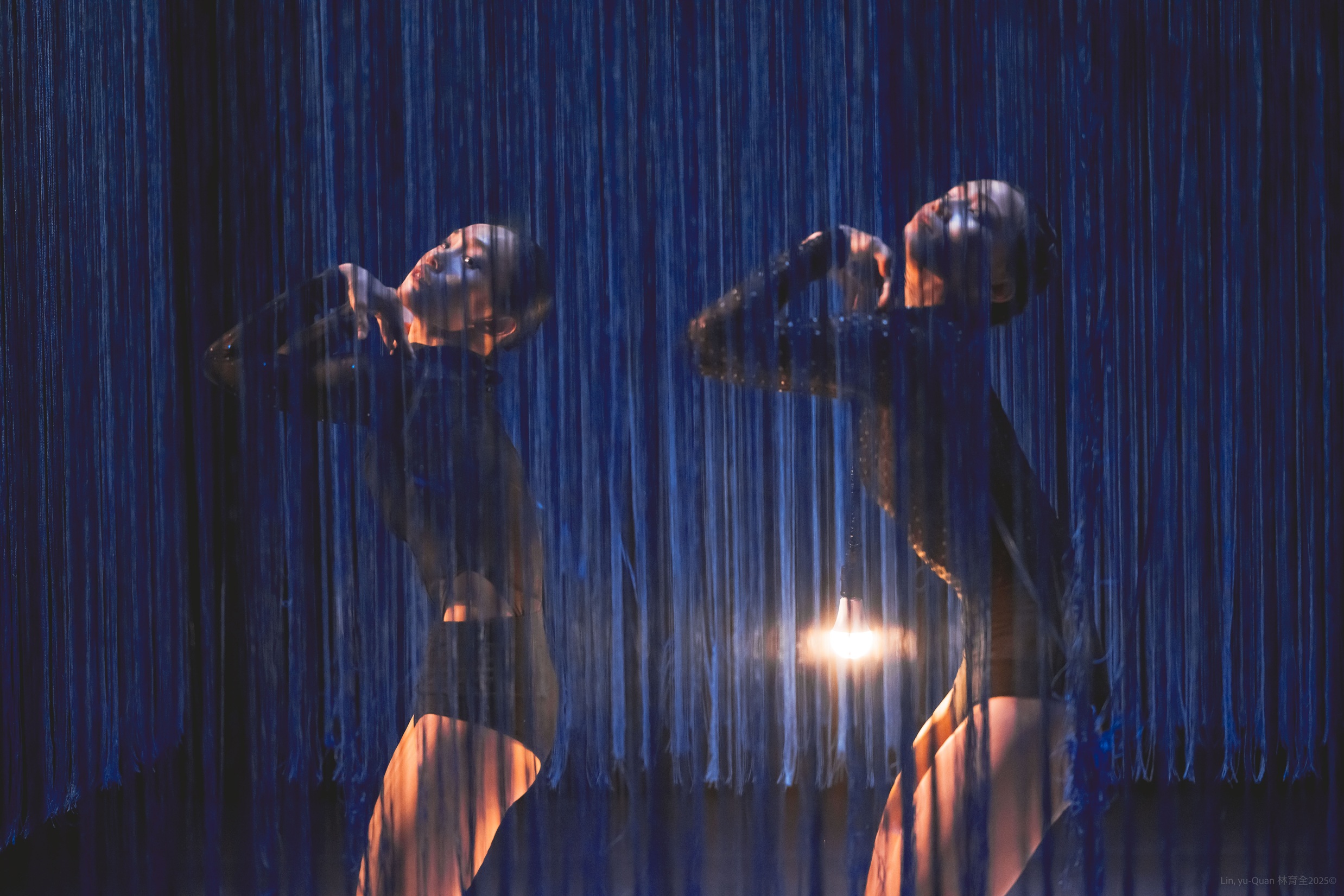
Production still of Blueprints, dancers between blue string curtains, Liang Ching-Yu and Cheng Wei (Courtesy of Yudance, photo by Lin Yu-Quan)
An Insomniac Woman in a Room of Her Own
Blueprints was Yudance Artistic Director and choreographer Lin Chun-Yu’s first dance piece presented at the National Theater & Concert Hall’s Experimental Theater. It was also the fourth production in the Yudance “Écriture Yīnyì” (陰翳書寫) series, following Yuri (百合.ゆり) in January 2022, the environmental theater piece Herstory (少女心) in March 2022, and the 2023 production She Said She Would Buy the Flowers Herself (她說她要自己去買花).
“Women are like treasures; I love women’s mystery, the way that when you peel back a layer, there’s another underneath it. Though that sense of mystery might be a bit like wanting to maintain a proper distance from others, it’s also a voice and a physical presence that moves subtly in a shroud of fog, yet still wants to be seen.” Speaking of her 2025 production, which continued the theme of “Écriture Yīnyì,” Chun-Yu gently yet firmly articulated her motivation for portraying women’s life experiences. Curious about why she had chosen the term, yīnyì (陰翳)1 , Chun-Yu admitted that, after contemplating for a while, she had come to realize she wanted her work to tell stories triggered by physical sensibilities rather than just focusing on gender issues.
This notion of yīnyì as a creative and conceptual vantage point was also evident in her work, Herstory. While the title might have suggested that it tackled social issues, it actually dealt with a much gentler topic, making it almost like Chun-Yu’s own version of The Little Prince. Blueprints also offered a narrative perspective. Though the production’s Chinese title, 月光顯影, literally means “moonlight imaging” or “moon prints,” the work did not necessarily refer to moonlight; rather, it focused on the emotional shifts and the flow of thoughts in a space bathed in diffused light.
“The title was decided once we entered the production phase because cyanotype is also known as ‘sun prints.’ By replacing the ‘sun’ with the ‘moon,’ we were essentially aiming to return to a feminine perspective.” Chun-Yu smiled and said that she had long suffered from severe insomnia and often felt most alert at night. “The idea of a woman in a room of her own is fascinating to me; she experiences many things that happen at night. It feels like the moment she closes her eyes is when the world would begin to turn.”
Thus, one segment of the piece was created by Chun-Yu around a story centered on a room at night.
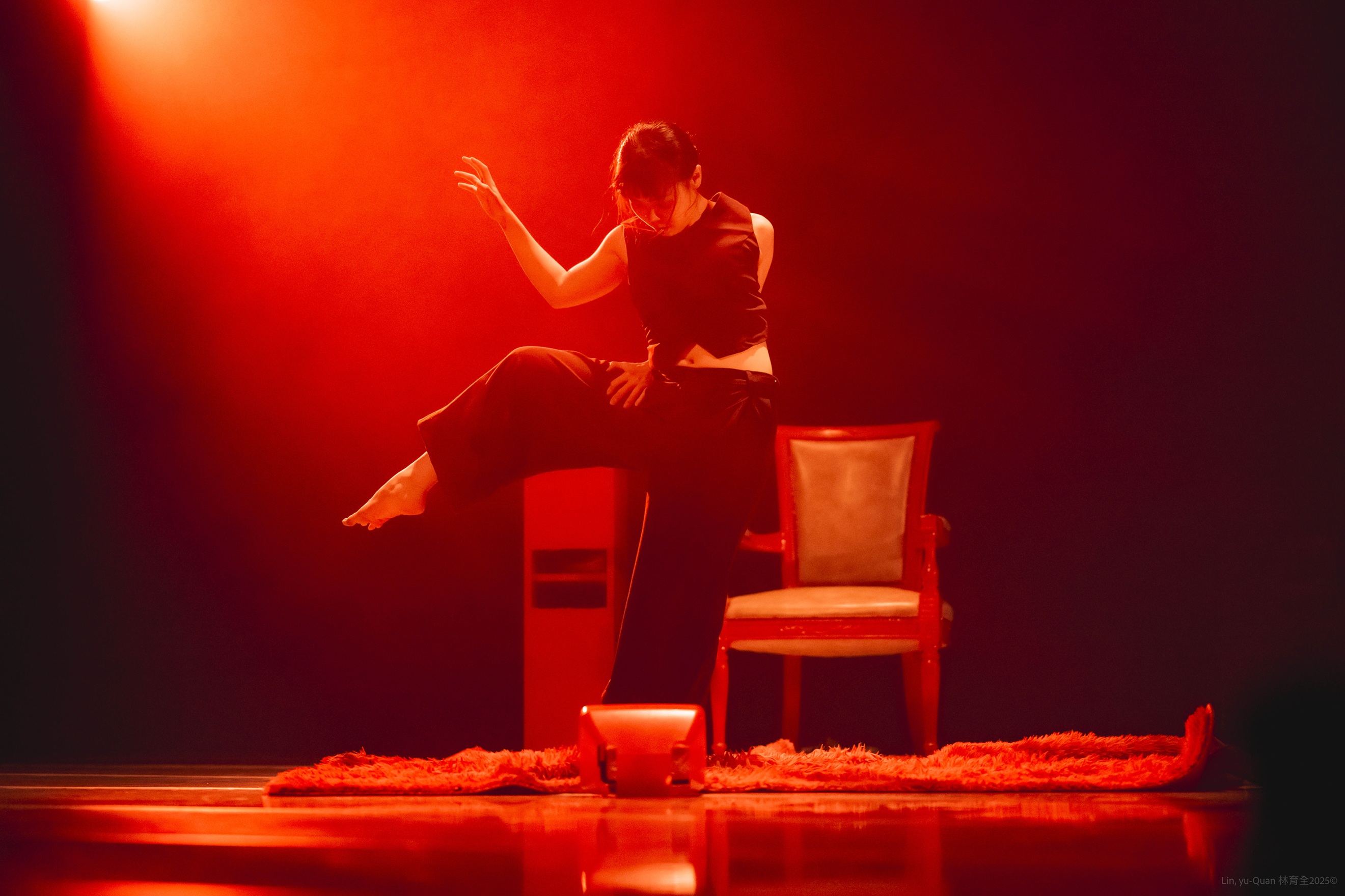
Production still of Blueprints, dancer Lu Shu-Hsien inside a red room (Courtesy of Yudance, photo by Lin Yu-Quan)
Chun-Yu has a cat at home and feels that cats are like extensions of oneself. So, she created a segment in the piece to explore the cat, a “graceful, surreal, mysterious, proud, exquisitely luminous” creature. Opening her notebook of choreography ideas, Chun-Yu bashfully showed me the elements of each of the three acts, their distinctly different color schemes, and the keywords for each. This act was set in the dead of night, with large string curtains forming a rectangular space. What connected the feline-like pas de deux to the first act was the blue strings pasted onto dancer Lai Wei-Chun’s face, which appeared like a river running from her eyes. “It’s as if I were lying in a river, dreaming. This dream takes me to an enormous room, accompanied by cats.”
Yudance’s Director and Dance Dramaturg, Lee Su-Yon, sometimes used his warm, gentle voice to ease Chun-Yu’s minor concerns: “I’ll help explain this part. If Chun-Yu feels there’s a need to revise or add anything, please feel free to jump in at any time.” Su-Yon noted that perhaps this was a case of “one work leading to another.” During the creative process, a particular segment might echo the state of a character from a previous work, creating an interesting dialogue and a unique quality. For example, Lu Shu-Hsien, who was featured in the “red room” solo dance, had also performed in She Said She Would Buy the Flowers Herself, which included a scene in which Shu-Hsien ran in with her eyes closed, stumbled into the space, and then everyone fell asleep.
“What we’re exploring this time is what happened to her right before she stumbled in with her eyes closed.” Who said subsequent works had to continue a story in a linear fashion? I thought this was one of the signs of Chun-Yu’s nimble and playful personality. It then felt as though Su-Yon’s explanation had flipped a switch in her, and Chun-Yu revealed an important personal discovery: “braiding hair” had been a recurring act in her work since Yuri, even though it wasn’t a predetermined element that absolutely had to be referenced. It simply kept popping up, whether with actual physical hair on someone’s body or as “hair” within the space.
Having heard this description before sneaking into the rehearsal, I hadn’t quite grasped the metaphor behind the latter at first, but I later realized that the massive blue string curtains, so striking and astonishing at first glance, served not only as a semi-tangible boundary for the rectangular space but could also symbolize hair, as well as function as a grating that filtered the moonlight until it became pristinely clear.
The dancers the audience saw were indeed right there in the midst of it all, yet as viewers gazed upon the scene, their own pupils also reflected the blue strings where reality and illusion blended. So, weren’t we, too, immersed in it? That was the magic of theater. Even more so, it was the parallel universe of a space created by Chun-Yu, filled with yīnyì-imbued memories.”
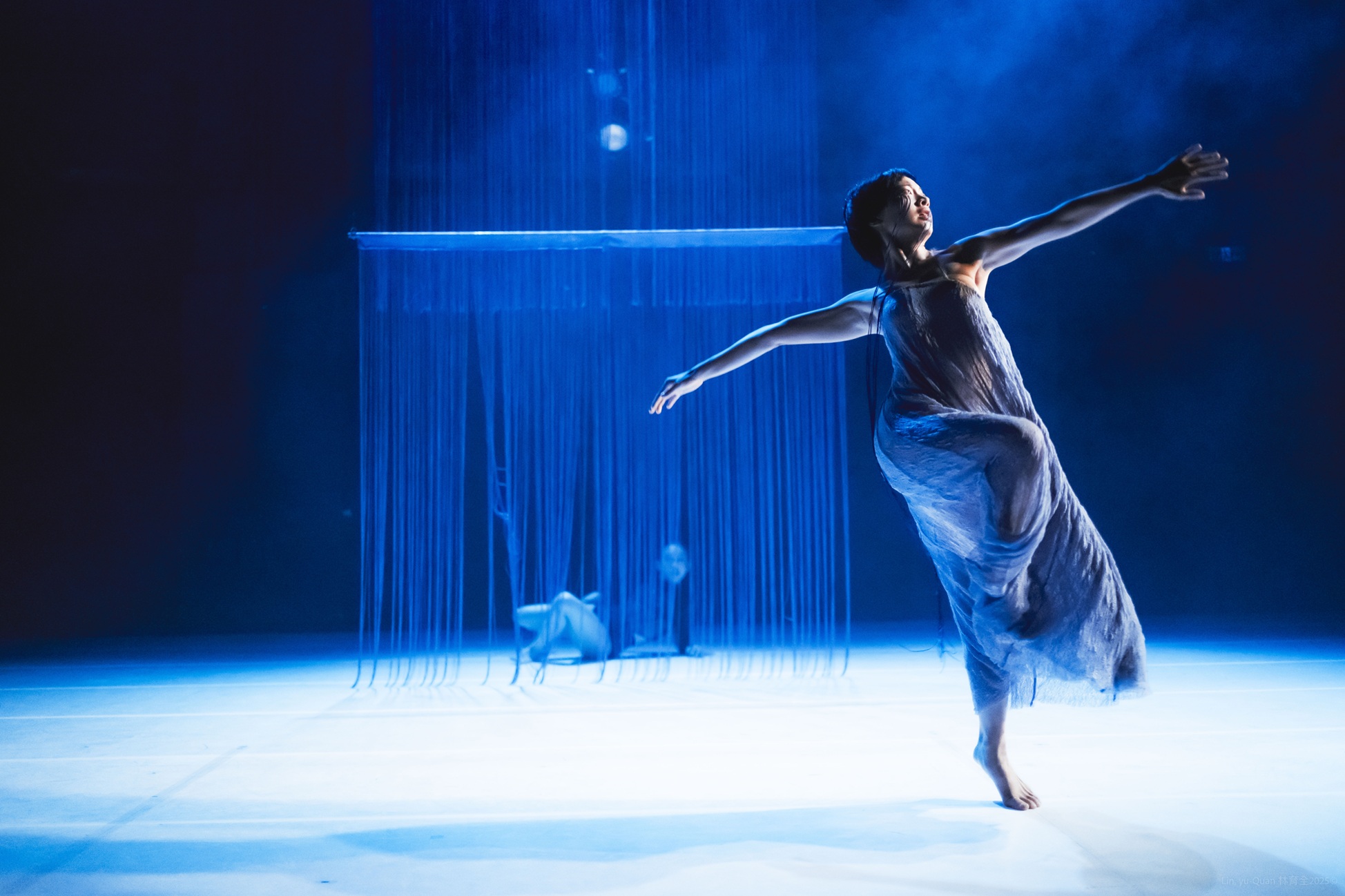
Production still of Blueprints, dancer Lai Wei-Chun (Courtesy of Yudance, photo by Lin Yu-Quan)
Choreography as Spatial Writing
As I attended several rehearsals during the rehearsal period leading up to production week, I often told friends, “I’m off to the ‘La Chambre Claire’!” The response I usually received was a mix of slight confusion and intense curiosity, with people wondering whether it was a place where “the physical space is always bright” or somewhere that would make “my heart and mind feel brighter.”
Neither, and yet both. What surprised everyone most was that it was a dance space, and it was uniquely fascinating both by day and by night.
One day, I finally got a chance to observe the dancers from the sidelines, starting just past noon. From the first floor, which was slightly dim and empty, I took the elevator up to the third floor. As I went up, I couldn’t help but recall how Chun-Yu had excitedly extended this invitation to me more than once: “If you come in the afternoon, you’ll see a very different ‘La Chambre Claire’ from the one at night! I’m sure you’ll love it!” As soon as I stepped into the space where everyone had gathered, I was instantly bathed in airy, clear sunlight. With one long wall covered in full-length mirrors and one short wall almost entirely taken up by large windows, I suddenly felt as though I were soaring above the city, drifting in midair and free to wander at my leisure.
The name of the space echoed Chun-Yu’s 2019 dance piece, “My intention from the get-go was that whether in everyday life or during times when things feel chaotic, I wanted for everyone to feel that there truly is a place where they can come take a breather and dream.” It was quite intriguing that a work so closely tied to the “darkroom” and “moonlight” was actually conceived in a “La Chambre Claire.”
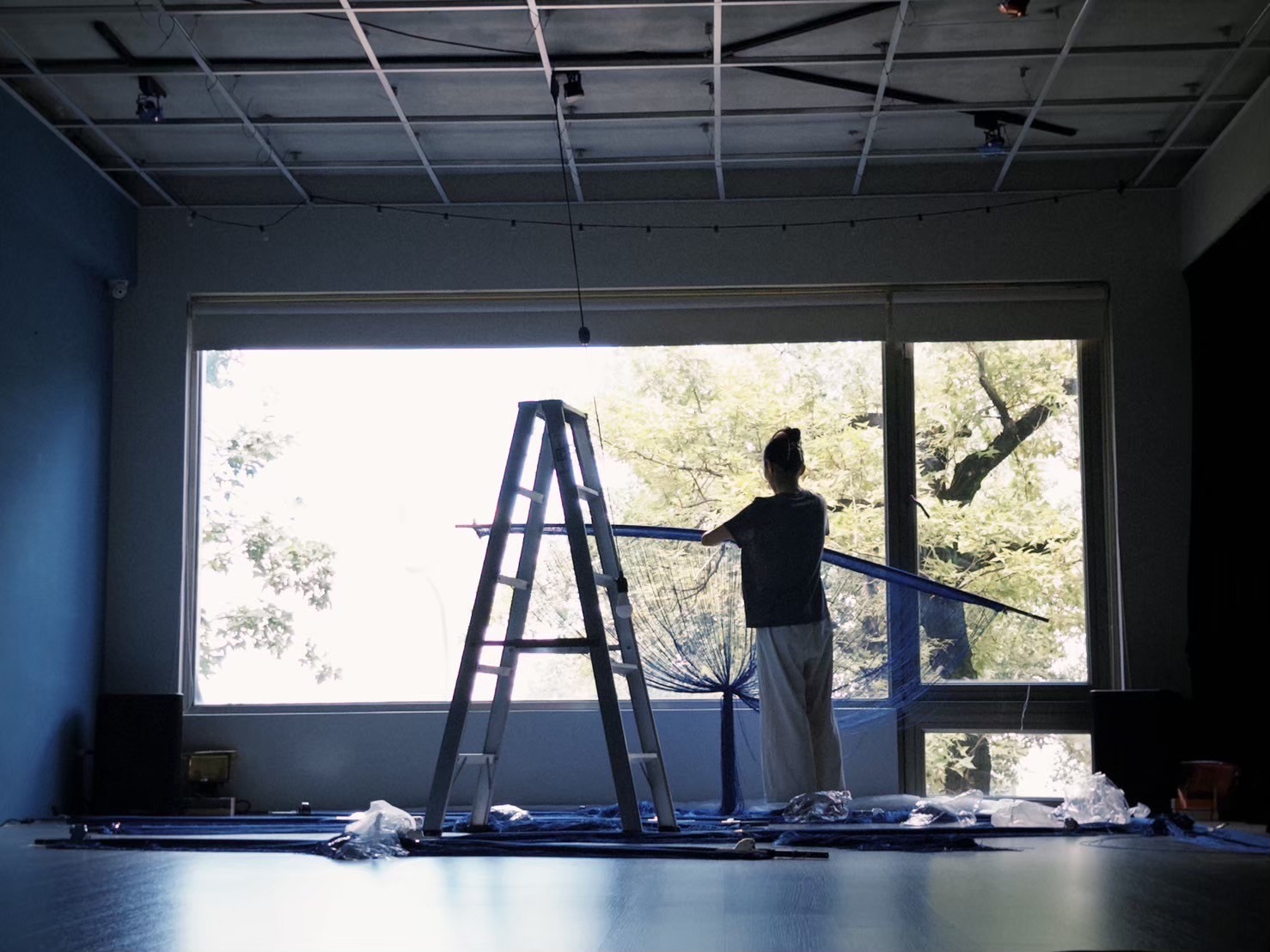
Yudance’s studio, “Well-Lighted Place,” is where dreams can take flight and where choreographer Lin Chun-Yu creates her dance pieces. (Courtesy of Yudance, photo by Liang Ching-Yu)
A house with palimpsestic rooms was an indispensable spatial element in Blueprints. Through casual conversations and interviews outside rehearsal hours, I learned that Chun-Yu’s mother was an interior designer, which, to some extent, had prompted her to explore different interior spatial conditions in her work. Chun-Yu found string curtains quite fascinating, which also sparked the idea of using them to create a rectangular space, so she went to Dadaocheng to check out numerous shops there. Accompanying her along the way, Su-Yon documented both the initial creative spark and the grueling yet unforgettable process: “The shop owners all said it was impossible to make that shape, so at first, she did it by hand, even going to a plumbing and electrical supply store to get custom-sized water pipes and asking the technicians there how to tie them.” Later, through refinements made by Stage Technical Director Daniel Jian-Ze Cho, the set in the first act took on its current form.
Su-Yon believed that such a process was also embodied. Using one’s own body to create a tangible space from an abstract concept, then placing numerous bodies in it, those bodies interacted with the space and began to dance, transforming into something even more captivating.
“Choreography, as a form of spatial writing, involves orchestrating individual and interpersonal relationships, and it is one of the central axes of this company’s overall artistic vision.” Su-Yon, with a background in literature and a body of creative work, offered this profound perspective. Some of Yudance’s works might be considered interdisciplinary experiments, but Chun-Yu explained, “Rather than thinking of it as applying two art forms to a single endeavor, it’s actually about realizing that we are all seeking a means of expression, with some doing it through dance and others through literature. Also, within each person’s familiar formats, we are trying to adapt others’ methods to understand how different art forms are expressed.”
Su-Yon added that from his literary perspective, he had also sensed strong dance-like qualities in many linguistic or textual works. Rather than focusing on what others might perceive as “interdisciplinary,” what exactly the “aesthetic interaction” within the work’s narrative would look like was something that Chun-Yu and Su-Yon frequently reflected on.
The Outside Eye and Someone to Talk to
A unique but understated aspect of the dance piece Blueprints was that, in addition to being the dance group’s Director, Lee Su-Yon was also its Dance Dramaturg.
This was a relatively new concept, having only recently been introduced to Taiwan, making it all the more intriguing to delve into the role’s function in the creative process. “Actually, similar roles have been seen in Taiwan in the past, such as the ‘creative companion.’ Recently, we have been hearing more about the term ‘dramaturgy’ in theatrical collaborations.” The way Su-Yon talked about this suggested that he believed he was simply doing what needed to be done, rather than purposely adding to or experimenting with the effects of a new role. According to Su-Yon, “Each person approaches dance dramaturgy differently. I set out to assist with contextualization, provide relevant insights for the creative process, and work jointly to find what’s best suited for the particular work.”
One key aspect involved providing feedback on the larger narrative structure within the planned creative framework. Another involved conceptualizing how to present the work to others, such as considering the connection between the music selected and each segment, or the conceptual design of a particular dancer’s role. Su-Yon felt that his role was more about providing companionship. He also compared it to literature: “It’s quite similar to the relationship between an author and an editor. I serve as the author’s external set of eyes and also someone to talk to throughout the creative process.”
A different preparatory step compared to before was also taken for this production. During the early stages, Su-Yon and Chun-Yu scheduled weekly discussion sessions and, in a meeting-like fashion, reviewed the work’s progress and identified areas needing adjustment. This effectively reduced the time spent during rehearsals. Chun-Yu wittily said that as a more emotion-focused person, she didn’t particularly like meetings; however, she acknowledged that the preliminary exchanges and discussions with the dance dramaturg had been very helpful.
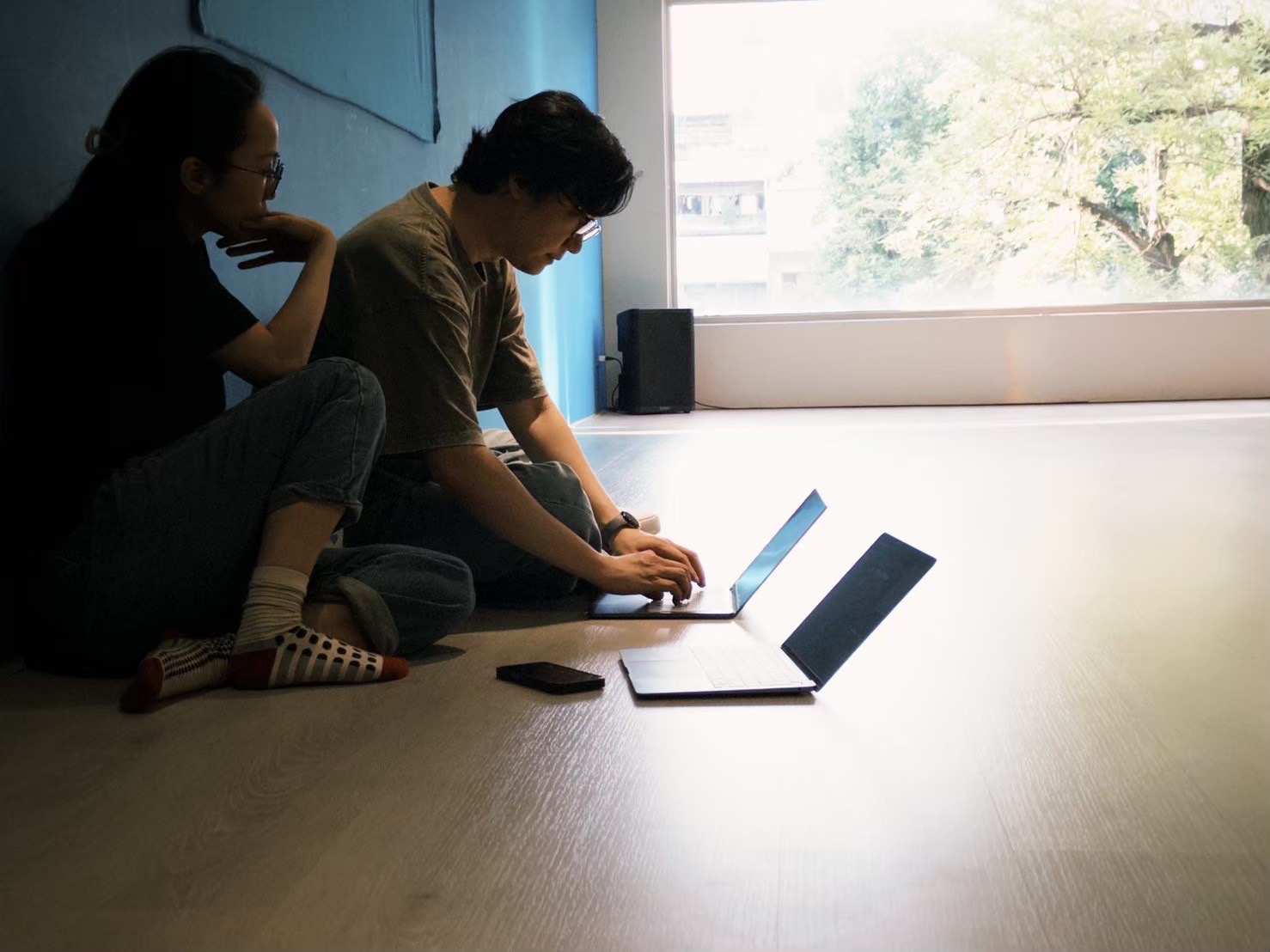
Blueprints’ Dance Dramaturg Lee Su-Yon taking part in a creative discussion (Courtesy of Yudance, photo by Liang Ching-Yu)
Chun-Yu began receiving formal dance training at school from a young age. After attending the dance program at Zhong-zheng Senior High School, she went on to study at the California Institute of the Arts. During her high school and college years, she discovered that improvisation was what she felt most at ease with and realized that choreography was where her passion and talent came together. After spending eight years abroad, she returned to Taiwan and, having yet to establish a network in the dance circle, began by choreographing and performing her own works. As she gradually made her way through the field, she began collaborating with various dancers and even rekindled past partnerships. And as someone with a passion for dancing, she would also take part in performances, including group dances.
“Later, I realized that I needed an outside eye to help assess the overall situation on site.” This led to the creation of the position of dance dramaturg. Not only did Su-Yon serve as that keen set of eyes overseeing everything, but he also worked alongside Chun-Yu to handle production-related matters, including providing comprehensive support for publicity and other matters. “I think I’m really good at coming up with names,” Su-Yon modestly said about his contribution to promotional copy. For example, “Light-Sensitive by Nature” was the phrase that Chun-Yu first came up with to express her concept. While out jogging one day, Su-Yon came up with “The Darkroom and The Women Share the Same Sensitivity to Light.” Adored by both, the latter became the production’s slogan, appearing on the ticketing platform and in the program brochure.
During the week leading up to the official performance, or production week, Su-Yon said the only role he could play in the theater was to help by observing and listening more. “During production week, I really enjoy listening to Su-Yon’s feedback every night.” As Chun-Yu started sharing more information, she also generously praised Su-Yon’s organizational skills. After all, for Chun-Yu and the other dancers, their focus lay more on the body’s sensibility and movement, so they had to rely on someone else to carry the work’s language and narrative.
When asked whether Su-Yon had any other experience with dance dramaturgy, he replied that most of it had been in Chun-Yu’s works, and the production Wordscapes, Bodyscapes, staged in June and July, had left a memorable impression on him. In that piece, Su-Yon and writer Yen Na each choreographed a dance piece based on their own prose writing. Since Su-Yon also served as a choreographer on that piece, he and Chun-Yu swapped roles. That experience allowed him to see his own limitations and helped him better appreciate the importance of a dance dramaturg in supporting the creative process and providing a comprehensive perspective.
“In this space, we share with each other our limitations; together, we can crack open many things.”
Multiple Factors Shaping the Dance
Besides the dance dramaturg, through increasing interactions with everyone involved in the Yudance production, as I gradually observed everyone and developed a sense of familiarity with them, it became evident that all of them—including the choreographer, dancers, lighting designer, and stage technical director—would quietly observe and pull out their phones to film and document whenever they didn’t have pressing tasks of their own. They would also proactively pay attention to various details during rehearsals and performances.
Just as the blue room in the piece relied on suspending string curtains from all four sides in different directions and required precise timing to orchestrate their raising and lowering in order to frame the “room” and fully convey the artistic concept, the completion of a dance piece also required dedication and mutual support from everyone involved.
Recalling my first time attending their rehearsal, given the limited time available to bring the four dancers together, Chun-Yu had them work on the quartet sequence from the third act first. I watched the four dancers unleash their individual strength and stylistic vigor through the same dance movements: they circled and spun around the space, then twirled closer together in unison, and finally bent forward, pressing close together in a line. I was deeply struck by their complete trust in one another. Amid the increasing speed, transitions, and shifts in posture, where even the slightest lapse in concentration or hesitation would have been instantly noticeable, they entrusted themselves to their fellow dancers during this very first joint rehearsal.
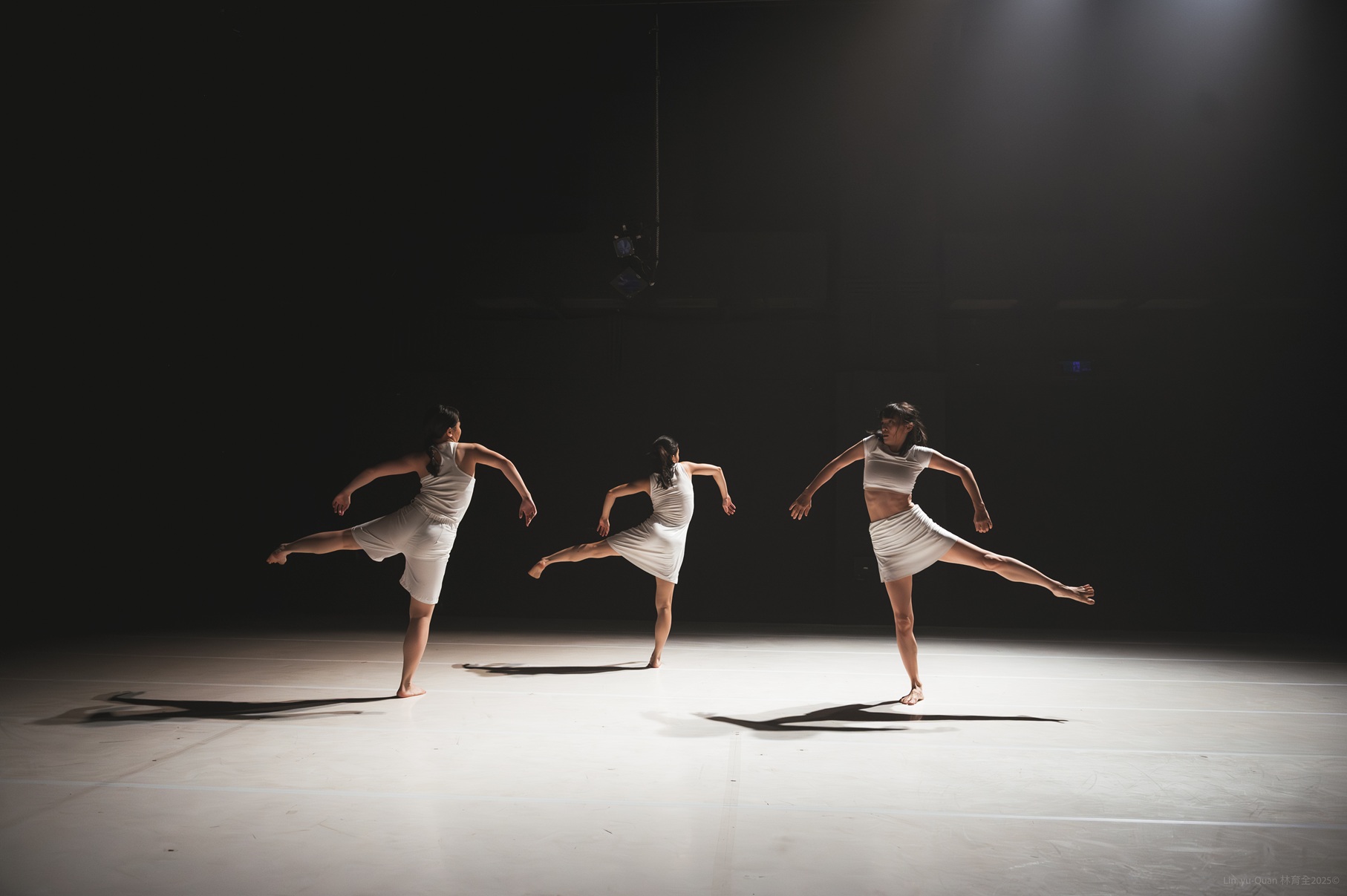
Blueprints group dance segment with dancers Liang Ching-Yu, Cheng Wei, and Lu Shu-Hsien (Courtesy of Yudance, photo by Lin Yu-Quan)
One of the defining characteristics of the group members was their natural, harmonious, and joyful way of interacting with one another. For example, during the first trial of hanging the eight sets of blue string curtains in the “La Chambre Claire,” the stage technical director, lighting designer, Chun-Yu, and Su-Yon worked together in the small studio space, trying to find the best way to simulate how the stage would be set up in the theater. Meanwhile, one dancer diligently practiced in front of a mirror, reviewing the steps for her solo performance, while the other three dancers gathered to try on props, experiment with hairstyles, and discuss whether someone should initiate cues for upcoming steps in certain segments of the performance, all while keeping an eye on the dancer practicing and on how the string curtains were being set up.
The chemistry between them made it seem as though the members of this group had collaborated more than three times before and shared a mutual understanding. With their inner flows intertwining, I stood on a nearby peak, overlooking this still-growing yet deeply luminous basin—a landscape so rich with vital energy that I couldn’t help but stop and admire.
Stage Technical Director Daniel and Lighting Designer Tee You, who joined the production during the later stages of rehearsals, were crucial during production week. In addition to focusing intently on the dancers’ movements and how the piece should be expressed, Chun-Yu often discussed and fine-tuned details with Daniel and Tee You, and even worked with them to experiment and see whether they could find better ways to make something work. For example, for the segment in which dancer Shu-Hsien bit down on a round mirror, it was integral for the mirror to cover her entire face as she moved, so they discussed the possibility of installing a component behind the mirror to make it easier for her to bite down on. They also discussed details such as whether, during segment transitions, the dancers might need to assist with switching lights or moving props. From something as big as the scenes to small props and the most subtle movement adjustments, discussions unfolded organically at “La Chambre Claire.” Through perspectives drawn from different technical fields and disciplines, those discussions evolved into even more stunning visual manifestations.
Once inside the theater, collaboration between multiple parties became even more crucial. The greater technical flexibility in staging and lighting meant that numerous details of the choreography had to be readjusted to suit the venue’s actual conditions. Other than the dancers, team members sat in the middle of the auditorium and in the front rows to monitor adjustments to the set, props, and lighting. From the audience’s vantage point, they examined and refined the work, shaping it into the complete vision they had in mind. Daniel and Tee You constantly checked with Chun-Yu to confirm whether a particular arrangement matched her vision, and whenever Chun-Yu encountered a problem or realized that the two technical support members might have a better approach, she communicated openly and calmly, then immediately tried it out.
Assuming that the meticulous refinement of all these details would end by the day before the official performance at the latest, upon seeing the first official performance, I discovered that further adjustments had been made even to the intermission. Originally, it had simply been a time to set up the various props needed for the red room during the break. Ching-Yu explained, “After Friday’s rehearsal, Chun-Yu mentioned she wasn’t sure yet about how the intermission would be set up.” She then followed up with a message to Chun-Yu, saying that it was fine to make any adjustments she wanted. Ching-Yu then added that she knew Chun-Yu had complete trust in her. So, in addition to adding a guitar segment, Chun-Yu asked Ching-Yu to find a way to reveal her eyes after the crew covered her and Shu-Hsien with a white plastic tarp. Then, with the glowing white tarp draped over them, Ching-Yu slowly exited the stage.
After the performance, I interviewed the dancers online. Every one of them said that, before the production week, they weren’t sure what the final performance would look like. This was also true of Chun-Yu’s approach to choreography, as she often preferred not to give specific instructions and instead valued the dancers’ interpretations and ways of expression. Combined with the lighting angles and colors, an entirely different world seemed to have been created. Even though she had been part of the performance herself, dancer Wei-Chun pointed out that she was still surprised in various ways when she saw the entire piece from the audience’s perspective, and the other three dancers immediately agreed with this sentiment. “I realized there were even more possibilities for presenting the piece. For example, after the final segment, I only discovered from watching the video recording that the lighting was focused solely on the feet.”
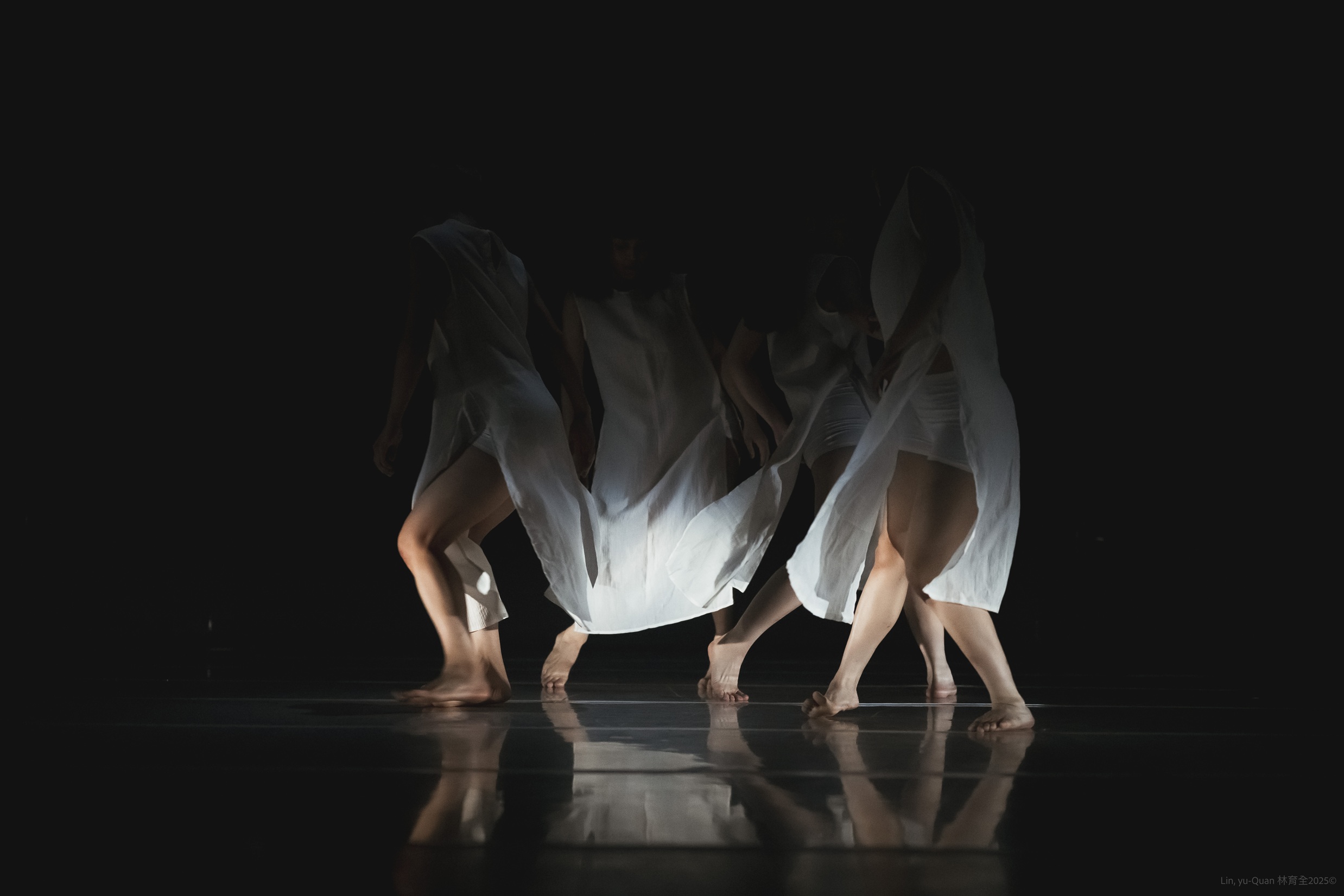
Blueprints group dance segment with dancers Liang Ching-Yu, Cheng Wei, Lu Shu-Hsien, and Lai Wei-Chun (Courtesy of Yudance, photo by Lin Yu-Quan)
Subtle Expressions and Yīnyì Appreciation
During rehearsals, I also noticed that the four dancers, all younger than Chun-Yu, would naturally call her “big sis” or “teacher” when interacting with her. It wasn’t a matter of extreme formality or reservedness. Rather, while maintaining proper etiquette, they retained a sense of respect, friendliness, and sometimes even lighthearted banter. Both the dancers and Chun-Yu felt that these forms of address were not contrived. Since some of them had known and been taught by Chun-Yu since their student days, she had been called various titles or terms of endearment, and there was a strong sense of connection between them.
When asked whether the fact that all the dancers were cisgender women played a role, Chun-Yu candidly admitted that she initially had no specific criteria for selecting dancers. She looked for suitable performers based on past interactions and collaborations. While affirming the appropriateness of an all-female cast and expressing how comfortable they felt thanks to Chun-Yu’s willingness to listen to their ideas and give them creative freedom, the four dancers fell into deep thought when I asked, “Did you know in advance, or did you sense a connection to female/feminine power with this work?”
“I have a classmate who’s danced in one of Chun-Yu’s works before. I can’t remember if she asked Chun-Yu or me a similar question. It’s because Chun-Yu’s work tends to have that kind of sensibility. Chun-Yu has said, ‘Because I’m a woman, what I create will naturally reflect who we are.’” Reflecting on her experiences, as well as on her own bodily sensations, Shu-Hsien then added, “I feel I’m somewhat similar. It depends on what it is within the work that moves you, how it makes you feel, and what kind of response it elicits. It is not about interpreting it based on a predetermined gender framework, but how to naturally express those shapes and colors.”
Wei-Chun then also shared her thoughts: “Could it be that the female experience is the work itself? Chun-Yu is someone who possesses a soft, delicate sensibility; she tends to explore conditions that are usually overlooked, such as the concealed side or how people are when alone in a room. I’m usually not someone who is soft, but through this work, I was able to sense more of the feminine side of things.” Dancer Cheng Wei pondered for a while and said that she had later read the section in the program notes about the female perspective. Before that, she hadn’t realized that there were elements specifically prompted by femininity, but she did sense that they were related to Chun-Yu herself.
Perhaps leaving it unsaid was also part of Chun-Yu’s artistic expression. However, through the various layers of her choreography, Chun-Yu had also managed to let the female dancers experience, to some extent, the yīnyì undercurrents stemming from what she wanted to express as a choreographer.
From rehearsals to the theater and then to the official performance, the process paralleled the theater’s transition from total darkness, through the subtle or dramatic introduction of light during the performance, to the clear, revealing white light at the curtain call. From the beginning and throughout the process, repeated navigation in the dark, along with trial and error, was perhaps unavoidable. However, it was precisely because the members of this production team were all aware of their own light-sensitive nature—and were thus able to draw energy from the darkness and develop various manifestations of their creative vision—that they could lead those collectively enveloped in this pitch-black darkness, without using words, to delve into the dance’s overlapping, complex feminine space of memory.
NOTE
[1] Translator's Note: Yīnyì (陰翳) literally means “shadow” or “shade” and can also refer to the soft dimness created by diffused light. The first character, yīn (陰), also represents the feminine principle of the universe. In this series, the title references the French feminist literary theory écriture féminine (“women's writing”), draws on metaphors of moonlight and the interplay of light and darkness, and alludes more abstractly to notions of gender.
*Translator: Hui-Fen Anna Liao
More CASE STUDY

_1736490377300.jpg)