CASE STUDY
Constant Calamities—Interviews with Huang Shu-Mei on ‘For the Future You’
Lo Yi-Shan
2026.03.25


I. A Hyper-realistic Otherworld
When Huang Shu-Mei (黃淑梅) arrived at Tainan’s Cigu District in early 2023, the five-year-long demonstrations against solar farms in Cigu that began in 2018 had just ended. Recalling setting foot in Cigu, which is divided into east and west sides by Provincial Highway No. 61, Huang commented that it felt like being in a hyper-realistic otherworld. “I had no idea that Cigu had changed so much,” said Huang. The scene of fish ponds and oyster scaffolds from the past is now divided into two by this major national highway, and the east side has long been covered with photovoltaic panels, projecting a blinding white glare under the scorching sun. On the other hand, the west side has temporarily been spared from the development of solar farms after five years of protests. In November 2022, the then Deputy Minister of Economic Affairs, Tseng Wen-Sheng (曾文生), had said to Cigu residents who had gone up north to protest that he was not in support of photovoltaic development on the west side of Provincial Highway No. 61 and called on those in the photovoltaic industry to give up applying for development projects in the area. However, it is uncertain how long this verbal promise would last.
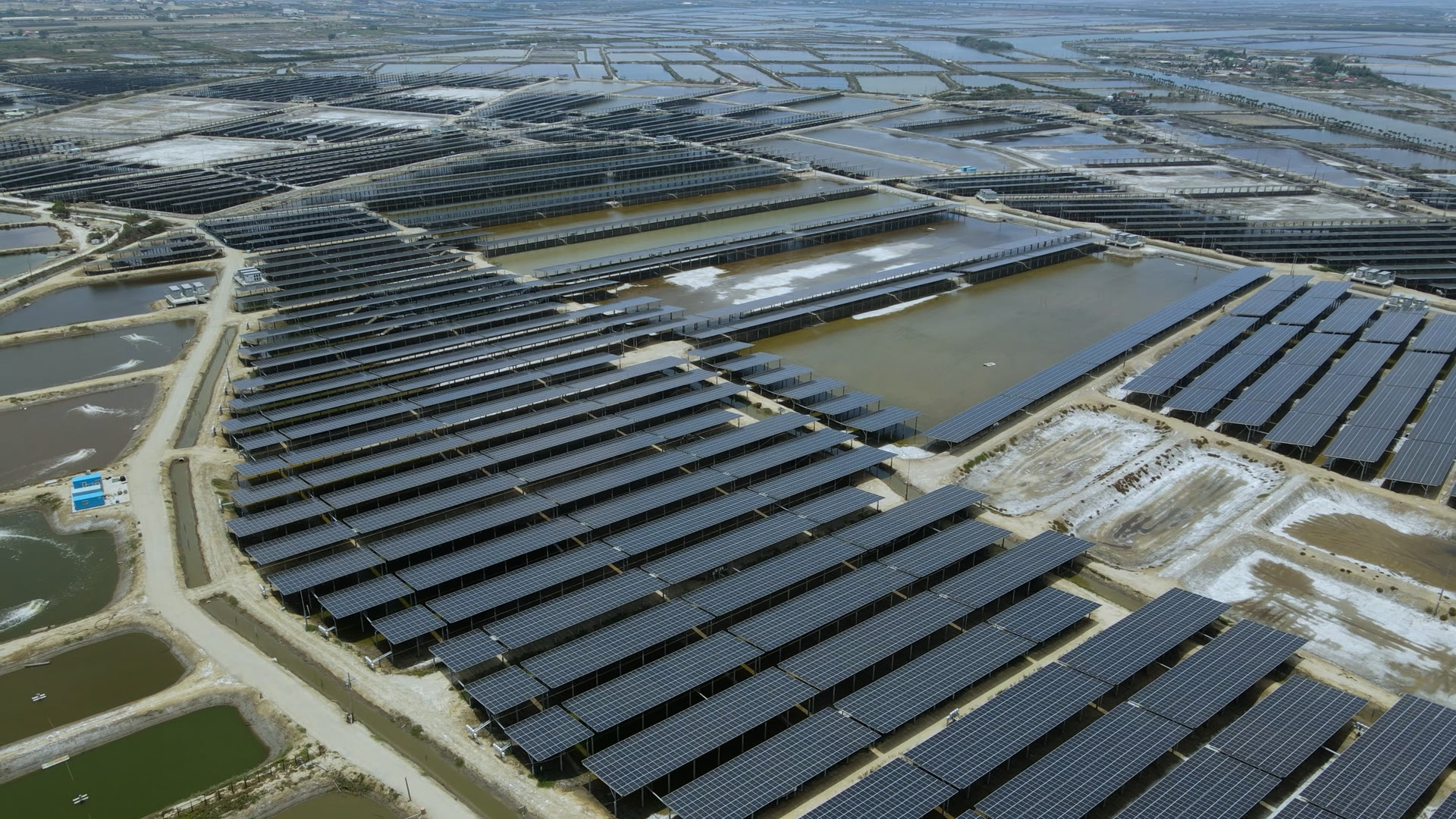
A scene from For the Future You (給未來的你); farming and fishing grounds in central and southern Taiwan have undergone drastic changes due to policies on photovoltaic development. (Courtesy of Huang Shu-Mei)
When Huang reached out to Yang Hui-Chin (楊惠欽) in late 2023 for an interview, who’s president of the Association for the Protection of Coastal Land Resources (七股沿海土地資源保護協會) in Cigu and one of the key figures behind the protection of the natural aquaculture farms west of Provincial Highway No. 61, Yang responded with a tone of helplessness in his voice, “The resistance is already over; what more is there to say now? Maybe things will change after the 2024 presidential election.” Photovoltaic power remains a sensitive topic in the local community, and some of the residents opposed to the solar farms were interviewed with their voices disguised. Many have been hushed by those in the photovoltaic industry.
On December 26, 2023, just 20 days before the 2024 presidential election, I followed Huang to Cigu. We ate at Yang’s seafood eatery, the Hei Pi Restaurant. Yang recommended his personal favorites from the menu to us, and Huang chatted with him in a familiar and relaxed tone, but a sense of concern for the area west of Provincial Highway No. 61 loomed over the conversation. “Despite the verbal promise from the Ministry of Economic Affairs, the area west of Provincial Highway No. 61 is still not protected. Some of the land belongs to landowners who have already acquired the land during the planning of Taiwan’s seventh naphtha cracker plant, and they eagerly await an opportunity to sell the land to the photovoltaic industry.”
In 1994, Cigu was initially designated as the development site of the Bin-nan Industrial Zone (濱南工業區), a steel mill, and the seventh naphtha cracker plant. However, after a 17-year-long protest against the development of the seventh naphtha cracker, heavy industries were halted from entering the area in 2010. Less than a decade after the end of the protest, Cigu became the subject of another wave of development. This time, instead of the traditional heavy “brown industries,” it is being sought after by a large-scale renewable energy industry packaged under the catchphrases of “clean and green energy” and “fishery and electricity symbiosis.”
In 1994, Cigu was initially designated as the development site of the Bin-nan Industrial Zone (濱南工業區), a steel mill, and the seventh naphtha cracker plant. However, after a 17-year-long protest against the development of the seventh naphtha cracker, heavy industries were halted from entering the area in 2010. Less than a decade after the end of the protest, Cigu became the subject of another wave of development. This time, instead of the traditional heavy “brown industries,” it is being sought after by a large-scale renewable energy industry packaged under the catchphrases of “clean and green energy” and “fishery and electricity symbiosis.”
“Cigu is the last pure land on the southwest coast of Taiwan,” said Huang. Because the hard ground in Cigu is not suitable for groundwater extraction, local fishers use pure seawater for low-density natural aquaculture, unlike the high-density aquaculture groundwater model found in Chiayi’s Dongshi or Yunlin and Pingtung. The natural breeding grounds created due to the area’s unique geographical conditions have not only prevented Cigu from land subsidence due to over-pumping of groundwater but also allow the coastal land to accommodate the black-faced spoonbills that migrate to Taiwan in September and October each year, making it a winter habitat for these migratory birds. During the winter fishery harvest, local fishers would intentionally delay the release of water from the fish ponds, maintaining a certain water level, so that black-faced spoonbills could feed on small fish and shrimps in the ponds.
However, the area’s ecologically friendly and natural aquaculture practices have also made Cigu a place of great interest for photovoltaic operators. Because the yield and profit of natural farming are not as stable as those for groundwater-based agriculture, Cigu’s land value is lower than that of other southwest coastal areas in Taiwan. The photovoltaic industry, therefore, recognizes the potential business opportunity in the area. Moreover, most of the fishers in the aquaculture industry in Cigu do not own the land they work on, and the landlords are often keen to lease their land to photovoltaic operators, who, for profit considerations, are willing to pay at least ten times more than the fishers. This would result in the fishers losing the space they have leased for aquaculture and thus losing their livelihood. “The residents are not blindly opposed to renewable energy, but they want to develop it in a way that considers the livelihood of the local people and environmental and ecological sustainability,” explained Huang.
After our meal, we said goodbye to Mr. Yang and drove onto Provincial Highway No. 61, heading to Luzhugou Fishing Harbor in Tainan’s Beimen District, where Huang was scheduled for a talk with the young man who founded the Luzhugou Oyster Park (蘆竹溝蚵學園區). While sitting in the passenger seat during the car ride, she discussed the interview details with the event’s photographer, who was driving. At the same time, she looked out the window at the photovoltaic panels covering what had once been fish ponds. Nowadays, this otherworldly landscape has become a sight she has seen countless times.
As the car entered the alleyways of Luzhugou, piles of oyster shells as tall as a person and black plastic baskets holding more shells were stacked in front of the townhouses on both sides. The unique local oyster production process does not involve soaking the oysters in water, which prevents them from developing a fishy odor, allowing the air in the village to remain fresh. In a village like this, the sound of traveling vendor cars announcing the goods being sold can still be heard occasionally. “This is a small village, and instead of going to big physical stores, people rely on their sense of hearing to conjure up images,” Huang said calmly and softly.
When we arrived at the Luzhugou Oyster Park, which is adjacent to the Beimen Lagoon, the young man we were about to interview was cleaning up a dead horseshoe crab at the park’s entrance. Next to him was an aquaculture pond for Taiwan’s native lobsters and milkfish, which are used as indicators of water quality. The young man greeted us enthusiastically and led us on a small path to the Beimen Lagoon. Sunlight was filtering through heavy clouds from the west, and as we walked along the path and looked southwards at the village, we saw a seemingly endless sea of photovoltaic panels. “After many unsuccessful attempts to resist the entry of the photovoltaic industry, we then decided to transform the sense of injustice we felt into a force for the local community. This was why the Luzhugou Oyster Park was founded,” explained the young man.
Huang followed closely behind him the entire way, and this way of following others, observing, and inspecting has been an approach of hers long before Cigu and Luzhugou. Since the end of 2015, Huang has personally visited several areas in central and southern Taiwan that have long suffered from industrial pollution and development injustice, including Taixi Village in Dacheng Township, Changhua, Xuejia District, Tainan, and Dalinpu, Kaohsiung. She would make her way to sites of protests, talk to local people, and document their daily lives beyond the protests and outside of the disaster areas. She would also visit prominent figures in environmental groups, academia, the industry, and government institutions. Fierce and bold, she doesn’t shy away from asking tough questions but is also humble and gentle, open enough for others to persuade her with their words.
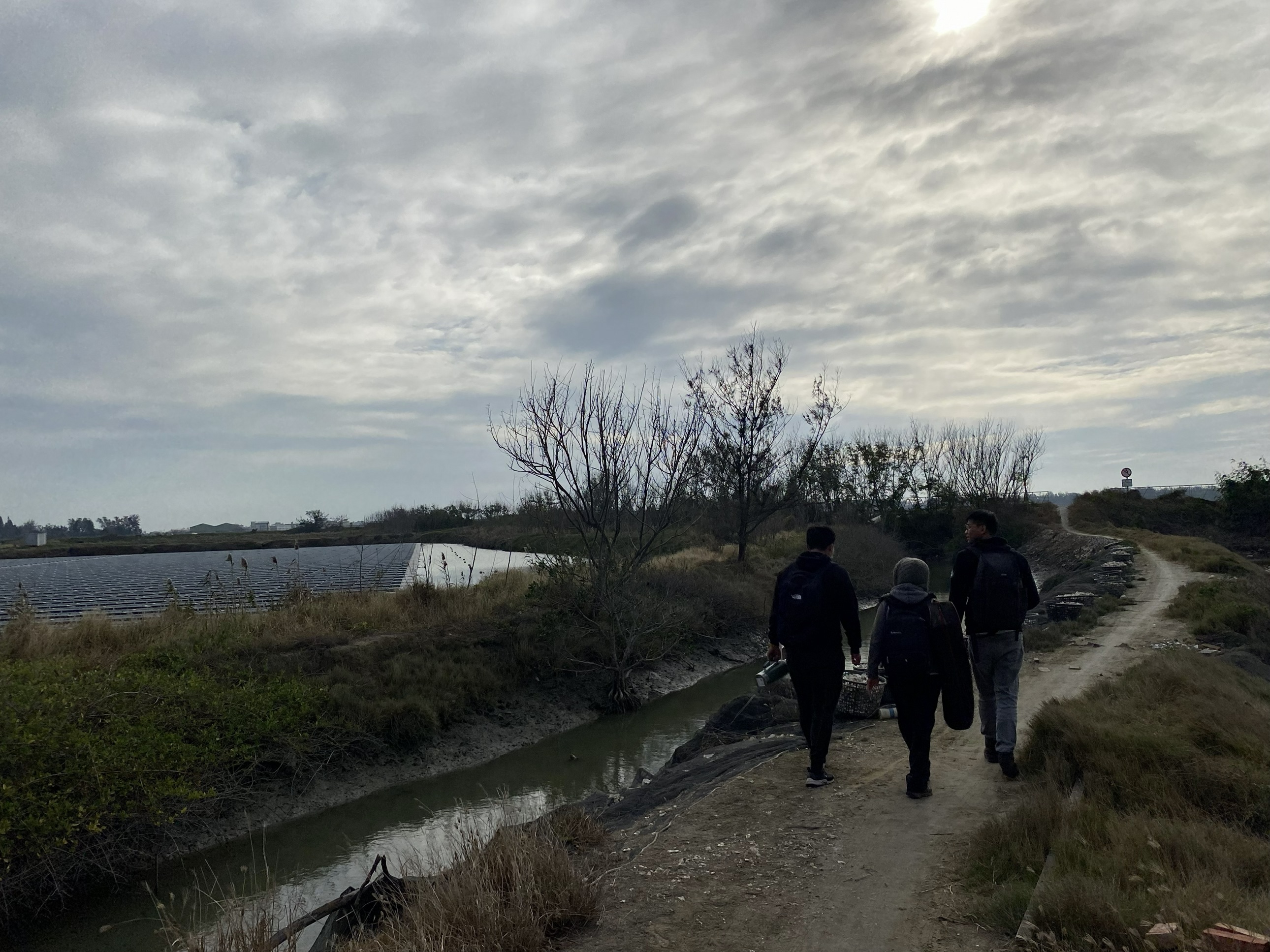
Director Huang Shu-Mei follows a young man from Luzhugou to the Beimen Lagoon; the fish pond on the left of the path is covered with photovoltaic panels. (Photograph and caption by Lo Yi-Shan)
The reason behind what she does is that she wants to leave a record for future generations, and it is this belief that has driven her to take action and document everything on film over the last decade. By calling this long-term documentary film project For the Future You, she does not intend to seek immediate, effective responses to present demands, but rather to engage in a dialogue with a future world that has yet to take shape and arrive.
II. Displacement of Time
The locations filmed in For the Future You are usually not the scenes of conflict, where ongoing disasters and protests occur; instead, the focus is on the concealed yet real remnants left behind in the aftermath. This displacement of time seems to imply the trajectory of Huang’s internal progression since the environmental documentary she made at the end of the last century, on the 921 Earthquake in 1999, which delineated the memories of generations of people in Taiwan. This was when Huang began to develop and refine her vision. After seven years of accumulating and organizing footage shot at the disaster area and post-disaster reconstructions, she finally released her first feature-length documentary film, An Encounter with Chungliao (在中寮相遇), in 2006.
Twenty-five years later, Huang now considers the experience of picking up a camera and entering the disaster area for filming An Encounter with Chungliao an essential foundation and support for her. She was trained at school to make films about people’s stories, but she was deeply impacted when she went into the area struck by the earthquake: “For the first time, I profoundly realized that in the face of such a catastrophic disaster and seeing the complex policies behind it, it was far from enough just to film the people. However, my education and training in Taiwan emphasized sentimental stories based on people’s experiences, and captivating stories about people are what’s preferred.” Even when she witnessed the kind of life that those in the disaster area were under, she longed to see beyond the tragedy on the surface; she wanted to delve into the colossal structure lurking underneath, and how it was like water that was all-pervading and seeping into every nook and cranny of people’s lives.
“I wanted to shift the emotional gaze on the victims to focus on structural and historical issues.” Thus, this structure-oriented vision formed during the production of An Encounter with Chungliao has become critical in Huang’s subsequent works. In 2009, a decade after the 921 Earthquake, Typhoon Morakot (also known as the 88 Flood) caused a landslide that buried Shiaolin Village in Kaohsiung’s Chiahsien Township. “After the 88 Flood, I kept pushing back the thought of heading to the disaster scene to document what had happened. I didn’t want to make another disaster film.” What finally drove her to the scene were these words of then-President Ma Ying-Jeou: “The reason why Typhoon Morakot caused such a big catastrophe was because God had dumped down a year’s worth of rain in the span of just a few days.” Thinking back to those words, Huang still couldn’t hold back her anger, “How dare they blame it all on the natural disaster and not take any accountability for the government’s inaction?” She was then determined to investigate the causes behind the landslide and embarked on a six-year filming and production process for the film, For My Dear Children (給親愛的孩子, 2015).
In For My Dear Children, Huang shifted her focus away from the present and was no longer rushing to every scene of the disaster, seeking to break away from the timescale of individual lives and to trace the history of Taiwan’s deforestation. Her reason for tracing back is to venture into the future: “For My Dear Children is a letter to future generations.” The timescale of the environment is much grander than the scale of human life; the issues involved often require prolonged documentation to see any change; this then prompted Huang to begin exploring “intergenerational environmental justice” with “future children” as the subject of her narrative.
This creative approach is also evident in her ongoing production of the feature-length documentary, For the Future You. The making of this feature-length documentary can be traced back to 2014, when Huang, from southern Taiwan, had first-hand experience of the harm that air pollution can cause. “Due to my vulnerable physical conditions, I’m someone who would likely not survive extreme weather,” she said self-mockingly. “I’m so sensitive that I would feel it immediately when the air is bad or there’s a drastic change in the weather.” Compared to visible disasters, such as earthquakes or landslides, at the time, the public still largely lacked awareness of the crisis that air pollution could bring; it is a different kind of disaster that’s invisible but pervasive. PM2.5 particles are suspended in the air and can even penetrate the barrier between the internal body and the outside environment, entering deep into cells and bloodstreams, with the impact lasting for generations to come.
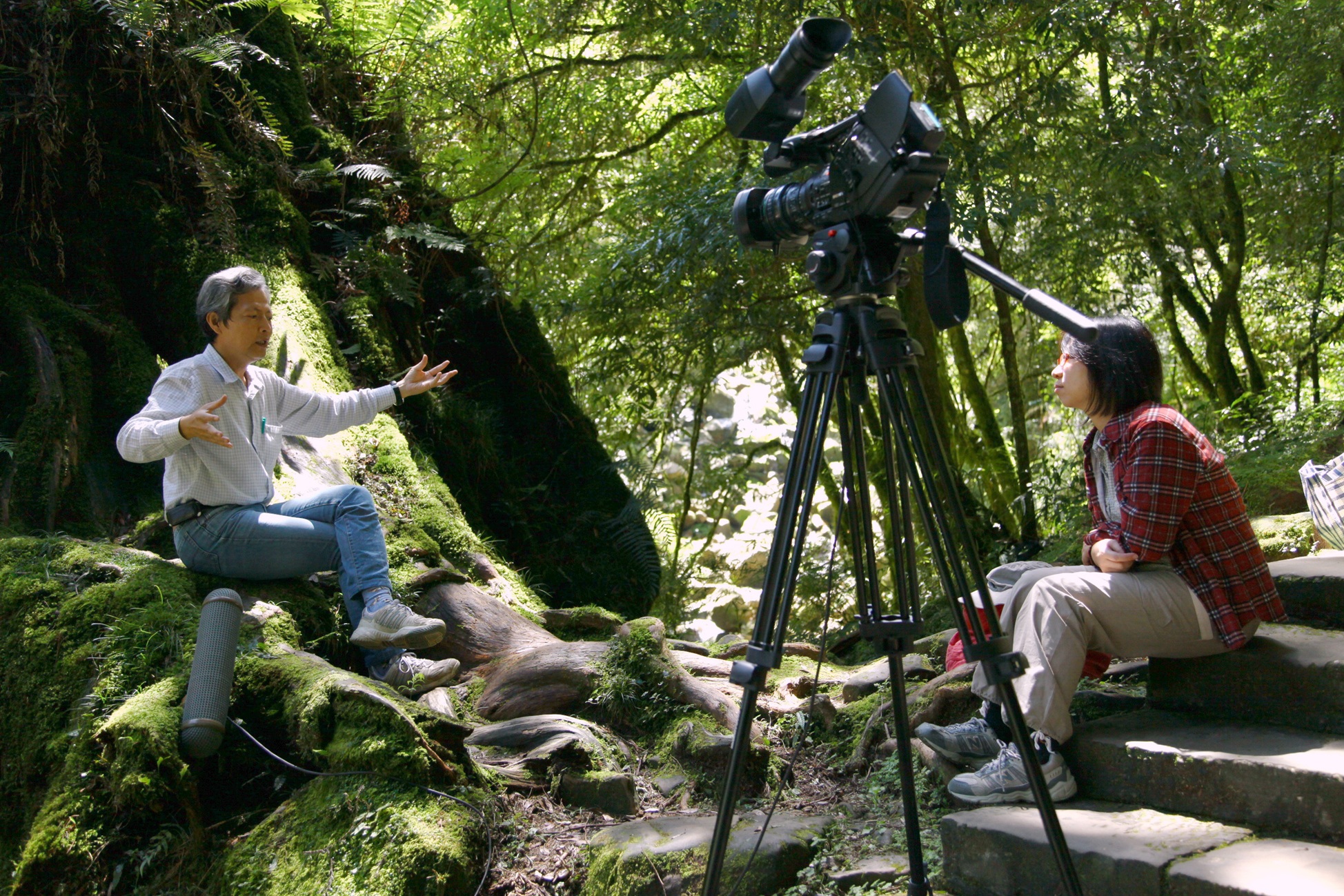
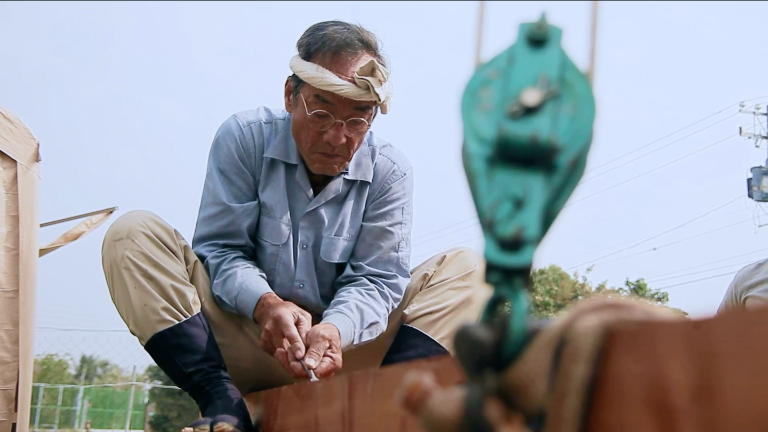
For My Dear Children is an attempt to use a broader environmental timescale to explore the issues of intergenerational environmental justice. Pictured here is director Huang Shu-Mei interviewing ecologist Chen Yu-Feng (陳玉峯) in a cypress forest of Alishan. (Photo courtesy of Huang Shu-Mei)
In 2016, together with several filmmakers based in central and southern Taiwan, including Tsai Tsung-Lung (蔡崇隆), Lin Tay-Jou (林泰州), and Lee Meng-Jer (李孟哲), Huang initiated the film activism project, “Mask Off, In Search of the Blue Sky” (脫口罩!找藍天). Huang then released the short film "Finding Blue Sky for Children" (為孩子找回藍天, 2016) for the project, which was her first attempt at addressing air pollution. Ultimately, this film activism project brought together 17 short films created by filmmakers across different generations, which were screened throughout Taiwan, accompanied by seminars that engaged representatives from the government, industry, and academia in dialogue.
In the same year, Taiwan went through a change in political parties after eight years, and the newly elected president, Tsai Ing-Wen, proposed her administration’s goal of making Taiwan a nuclear-free homeland by 2025, along with initiating policies on energy transition, aiming for an energy mix containing 50% natural gas, 30% coal, and 20% renewable energy by 2025. “Initially, I was happy to see this policy and the proposed proportions,” asserted Huang. In the subsequent few years, she continued to make short films on air pollution activism, and in 2017, she released the film, The Children’s sky (孩子的天空), featuring residents of Taixi Village in Changhua’s Dacheng Township.
The turning point for her to start making feature-length films came in 2019, when she was commissioned by Dr. Yeh Guang-Perng (葉光芃), founder of AIR Clean Taiwan (ACT, 台灣健康空氣行動聯盟), to create an activism short film on coal phase-out, which led to the production of Happy Birthday to You (祝你生日快樂, 2019).
“Making this short film made me realize that the air pollution problem is not just about air pollution; it is also closely related to industrial and energy transition, and even global climate change.” She further explained that if she continued to treat air pollution as a single, closed-ended issue, the film’s narrative would be limited to the circumstances faced by the victims and unable to point out the underlying institutional causes. “Air pollution is the long-term result of the country’s industrial structure and economic policies. Taiwan’s past economic growth relied on the ‘brown industries’ with high energy and water consumption, and these industries are the culprit behind environmental pollution.” This realization also allowed her to see the limitations of the short film format; activism short films, with the main purpose of conveying a demand on a specific issue, are usually used to present a one-sided appeal, but feature-length films can connect the different “points” on an issue into a “plane,” forming a cohesive, network-like structure/framework.
During the course of this “point-to-plane” pursuit, Huang also underwent a change of mind regarding her initial optimistic attitude towards the energy transition policy and the development of renewable energy. “Taiwan has started too late on our energy transition and lacks suitable supporting measures. The proportion of renewable energy generation in Taiwan was only 4.8% in 2016, and it is quite a frightening thought to aim to increase it to 20% by 2025, especially since Taiwan has minimal land and a fragile system that it is completely unable to cope with such a drastic policy,” said Huang.
Furthermore, the global industrial chain’s demand for green energy production has led many large Taiwanese companies to chase after the ultimate numbers on the green energy index, neglecting what goes on behind the energy transition and the procedural justice of the development process. This kind of consequentialist thinking has exacerbated the long-standing inequality in resource distribution. With capitalism’s inevitable pursuit of profit, the renewable energy industry has shifted and externalized its development costs to the periphery. Yet, most of the green energy produced has been acquired by large corporations or factories, making it difficult for the area’s residents, who have borne the development costs, to use the green energy. Huang said helplessly, “During an interview with a young man from Luzhugou, he told me, ‘We don’t even get to use a single watt of the green electricity generated from the photovoltaic panels built on our fish farms.” Whenever energy issues are being discussed, there are bound to be people who claim that there is not enough electricity to go around Taiwan, but the lack of electricity is misinformation.
Compared to “centralized generation of electricity,” which involves large-scale development on a single plot of land, the way Huang sees it, renewable energy development should start with “small-scale decentralized electricity generation.” For example, with the government’s subsidies and supporting measures, photovoltaic panels can be installed on the rooftop of each household to produce electricity for their own use or for the neighborhood. “If that’s not enough, then discussions can be held on how a certain portion of a piece of land can be developed in a gradual and orderly manner.” However, the business opportunities presented to corporations through large-scale land acquisitions and development, as well as policies that prioritize rapid success and results, have led renewable energy development in Taiwan to adopt a centralized and large-scale strategy from the outset. “Short-sightedness is the root cause of all these problems,” Huang said heatedly.
Initially, Huang had named the film project After 2025 (2025之後). When asked why she had decided to forgo the original title which seemed to convey a firm intention to engage in a dialogue with today’s society, she said, “The hope I have in people today is dwindling. When it comes to the environment, we can’t just look at the immediate benefits before us, but we have to keep time in mind and consider the future,” she responded. Consequently, she has renamed the film For the Future You. Unlike her previous film, For My Dear Children, which stands in the present and traces the history of deforestation, For the Future You stands amid the ongoing changes of the present and pushes forward to pursue the future to come.
Despite shifting her focus to the future, Huang does not shy away from saying that she doesn’t intend to offer any false sense of hope through her work. “This film is an elegy for the environment and a wake-up call for the next generation.” Instead of seeing her resolve as negative pessimism and hopelessness, it is actually an assertive realization of the present situation. “I want to truthfully document all our generation’s behaviors and choices on the environment. I was fortunate to have been born in this era and can document what I have witnessed. Whether what we have done is right or wrong can only be judged by those in the future,” said Huang.
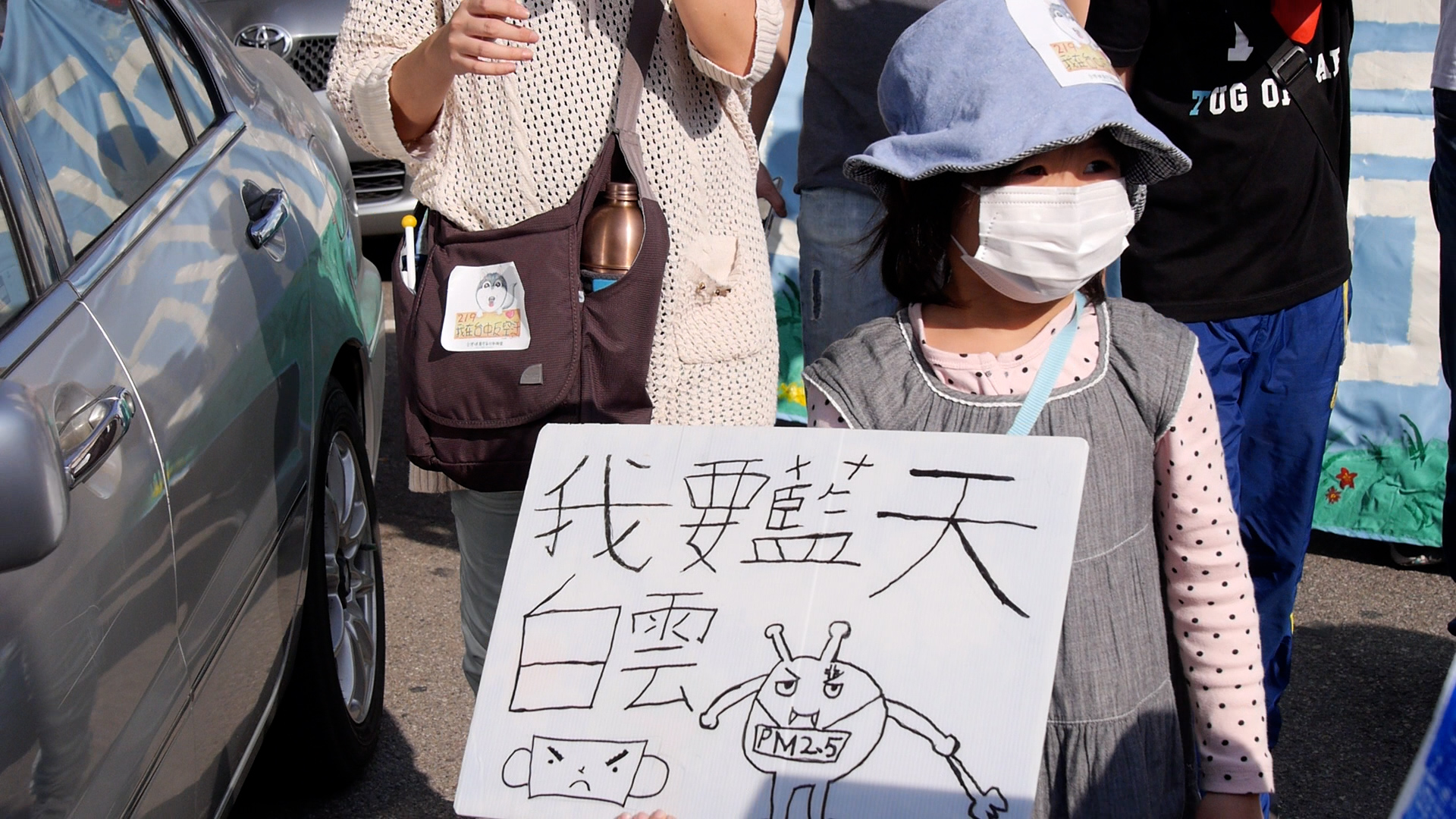
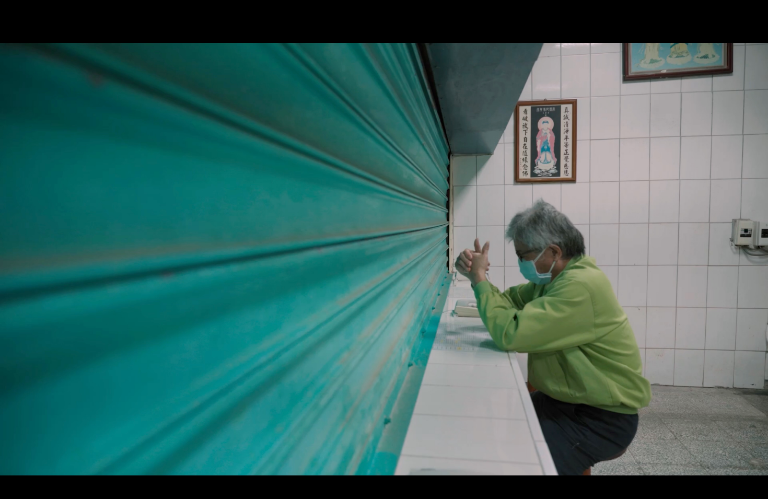
A scene from For the Future You. Through this film, director Huang Shu-Mei wishes to ask people of this generation: What are we leaving behind for the next generation? (Courtesy of Huang Shu-Mei)
III. Constant Calamities
At the end of 2023, while following Huang to Cigu and Luzhugou, filming of For the Future You was nearing completion. She contemplated the film’s narrative focus and format as she planned the last few interviews to capture on film. “After filming the solar farm situation in Cigu, I now have a better understanding on the reality of energy transition. I have become more aware of how to position and orient myself, which would better prepare me for the editing phase.” Huang sees the point when a documentary shooting ends as a deciding factor on where the director should trace back on the footage captured, “The perspective presented at the end of the film might also be limiting, so it’s imperative to look at the timeline from start to finish and see what has been covered across the board.”
The time frame for the production of For the Future You indeed shows a slice of time on Taiwan’s energy transition: It began with the handover of executive office in 2016, when the goal of diversifying the energy mix was proposed, leading to the intended schedule for completing the film’s production, which is in the year 2025, when the goal of the “2025 nuclear-free home” and the effectiveness of the energy transition will be reviewed. In the past ten years, Huang has been tracking different forms of pollution caused by traditional brown industries, the development process of the new green energy industries, and any environmental controversies, collecting a wide range of materials including interviews with experts and scholars, scientific knowledge and discourses on particular issues, documentation on everyday situations faced by local residents, and the protests. However, she admits that she is still uncertain about how to integrate the materials in a coherent narrative.
“A narrative form that can serve as a carrier for the materials is already there, but the real difficulty lies in identifying it.” For example, with the editing of For My Dear Children, the film’s opening alone took her three to four years to refine. “I had originally hoped to retrace the history of deforestation based on two historical disasters in Taiwan, the September 21 Earthquake and Typhoon Morakot, but the earthquake segment alone was half an hour long.” A monologue popped into her head one morning while she was barely awake. “I quickly got up and wrote it down, and it became the opening monologue of For My Dear Children; the process only took five minutes.
Fast-forward to For the Future You, Huang has chosen a first-person subjective view to narrate the film. “In addition to being more unrestricted, I can also take full responsibility for my viewpoint, limitations, and possible mistakes.” However, it is also apparent that her words reveal a kind of push-and-pull on how this work relates to her previous work: “I do not wish for this kind of first-person point of view to appear like a letter, just like in For My Dear Children.”
The tensions and ambiguities with editing the film’s narrative became much clearer a year later. By the end of 2024, when conducting another interview with Huang, For the Future You was in the stage of intensive footage reviews and editing outline. To think and reflect on the narrative, she had recently rewatched For My Dear Children: “I realized that I was still a bit naïve and immature at the time,” commented Huang with a smile. The way she sees it now, the narrative of For My Dear Children placed her, the director, at the forefront, and recounted everything to the audience in a straightforward tone, which sounded a bit juvenile and preachy. “At the time, I thought that I had to use the film to teach the system a lesson, and I felt that I could use documentary films to change many things.”
Today, Huang’s vision on “a director’s narrative position” has progressively pulled back and is concealed behind a narrative façade. This shift in self-positioning is undoubtedly closely related to how she has changed her mind on environmental issues. “For My Dear Children ended on a warm note, with the idea that after a catastrophe, nature will repair and continue to nurture life, and that amid crumbling fences and dilapidated walls, as long as people are still alive, there is still hope.” However, as she continues to work on environmental issues in the following decade, this original hope for the glory of humanity has gradually faded. “Now I just feel that the existence of the human race is a catastrophe for the planet and the root of environmental destruction,” stated Huang.
Consequently, the narrative of For the Future You is bound to be harsh; there are no heartwarming voice-overs from the director, but a quiet witness who has retreated behind a cool, calm camera. However, this doesn’t mean that the director’s point of view has disappeared: “The interviewees, the knowledge-based information, or the situations of the victims that are edited into the film, they all indicate the director’s point of view. The director’s point of view is pervasive throughout the film.” After realizing her narrative position as the director, the narrative format of For the Future You is now confirmed. The film’s narrative trajectory would be divided into two parts: The first part of the main narrative follows Huang’s decade-long journey from being optimistic about Taiwan’s energy transition policy to realizing it is fraught with problems. The second part consists more of a design-oriented approach that shows large-scale climate changes and disasters.
For Huang, climate disasters will not appear in the film in a dramatic, concrete manner; they have long been inescapable in everyone’s lives. “I want to stress the everyday nature of climate disasters.” Mentioning the radio program, “Earth ICU” (地球ICU), hosted by Prof. Wang Chung-Ho from the Institute of Earth Sciences at Academia Sinica, she explained, “Clips from this radio program will be presented as a voice-over to go along with my dashcam footage to create the feeling of listening to the radio during daily commutes in a car.” Envisioning the scenery outside the car window as anything from a hazy, smoggy sight to clear, cloudless skies or a seemingly endless and empty highway at night, a sense of uncertainty is suggested about the road ahead.
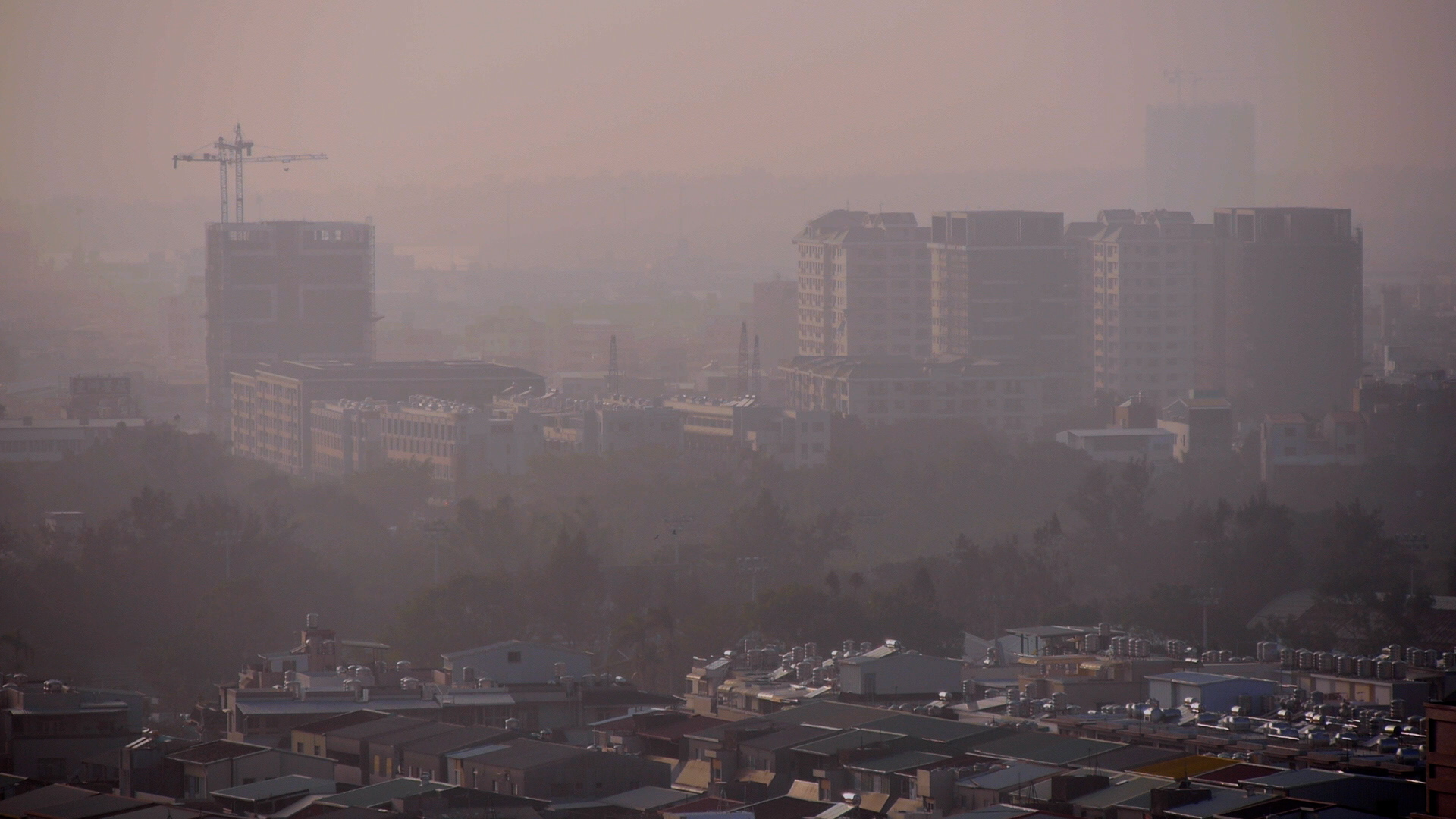
A scene from For the Future You. Central and southern Taiwan have long suffered from air pollution. (Courtesy of Huang Shu-Mei)
Amid familiar and unfamiliar scenes on an ordinary car ride, the radio program plays in the background, announcing disasters unfolding on the other side of the world. “I plan to write the script for the radio program based on international events related to climate change that have occurred between 2016 and 2024 and invite Prof. Wang to record it.” This spanning approach across the years also echoes the timeframe of For the Future You and Taiwan’s energy transition policy: “The dashcam footage and the radio program voice-over will serve as the film’s timeline, appearing as a bridge between each narrative segment.”
Listening to Huang share her thoughts on the narrative of this feature-length film, what came to mind were the numerous disasters and extreme weather events that have occurred in the year between my first interview with Huang to me following her to filming locations and then to our second interview: On April 3, Taiwan was hit by a powerful earthquake with its epicenter in Shoufeng, Hualien, which was the largest earthquake of its magnitude and intensity since September 21, 1999, and in less than a month, more than 100 earthquake swarms exceeding magnitude 4 occurred again. With the arrival of summer, the Northern Hemisphere experienced the hottest temperatures ever recorded. Ocean temperatures continue to rise due to global warming, which has drastically affected the Pacific typhoon season, with strong typhoons still occurring in mid-November. Moreover, various parts of Taiwan were severely hit by Typhoon Gaemi, Typhoon Krathon, and Typhoon Kong-rey, with floods and landslides impacting the geographically and socially vulnerable peripheral areas. By the end of 2024, Republican presidential candidate Donald Trump was elected on November 6, suggesting a bleak outlook for the global climate system and governance. The 2024 UN Climate Change Conference (COP29) commenced in the same month, but it was overshadowed by the absence of many heads of state from the high-level ministerial dialogue on the New Collective Quantified Goal (NCQG) for climate finance.
Not only in the immediate future, but right here and now, we are already living in constant calamities. In the face of this unavoidable reality, Huang said with a tone of helplessness, “Climate disasters have long been a problem not just about energy transition, but they have to do with our fundamental value system and mentality.” When asked about how she envisions For the Future You would engage in a dialogue with society after its release, she no longer holds the same expectations as she did a year ago, when she intended to “examine the vision of a nuclear-free home in 2025”. “If people continue to be shortsighted and only care about immediate benefits, it doesn’t matter what transitions are made with energy and the industries or how many documentaries are produced; they wouldn’t hold much meaning.”
She then shared an anecdote with me that occurred during her filming process. She had met a fisher in Cigu who had refused to leave, no matter how much the photovoltaic industry offered; he was even threatened by the mafia. “I asked him why, and his reply was quite simple: ‘I just like fish farming,’ he said.” Huang had repeatedly quoted this remark during our interview, a statement so simple, yet almost unheard of in today’s society. “How many people in Taiwan would still tell you, ‘I like fish farming, I like to be a farmer’?” Huang asked me this question, but at the same time, she also directed the question at herself.
A moment of silence followed that question, and I am reminded of the ending of For the Future You, which is still yet to be completed, but as explained by Huang, “I would like to end the film by showing the faces of many children of various ages, with them staring into the camera without uttering a word.” With the children’s gaze piercing through the camera, looking at Huang during the moment of filming, and also at the audience in the future who’s seeing the film on a screen, it symbolizes a perpetual gaze that every single one of “you” is projecting towards “me” and all of “us.” It is also an undaunted gaze in the face of constant calamities, to not give up, but also not naïvely remain hopeful.
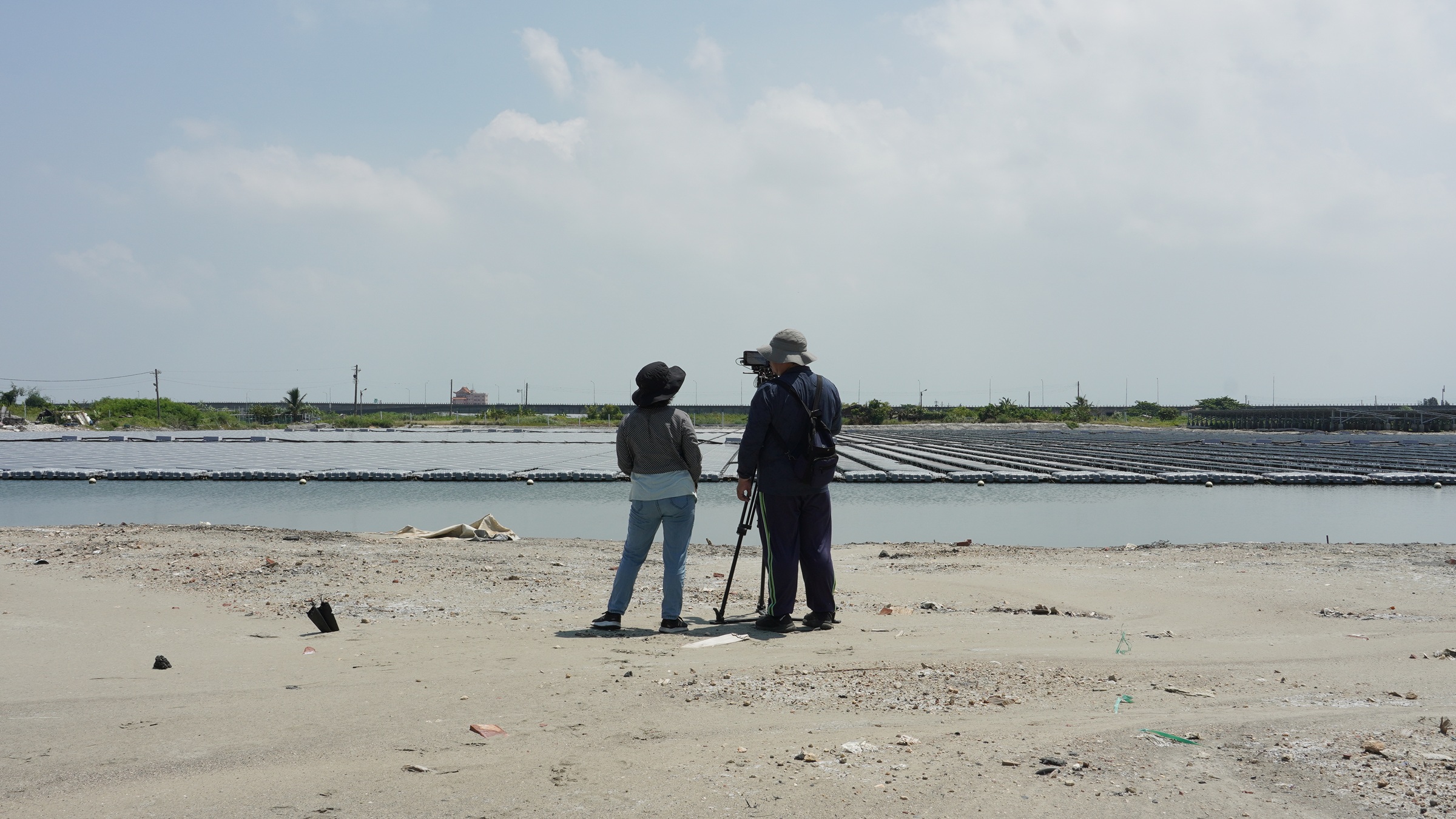
Filming of For the Future You (Courtesy of Huang Shu-Mei)
*Translator: Hui-Fen Anna Liao
More CASE STUDY
_1685344611325.png)