CASE STUDY
The Setbacks and Rebirth of Motherhood - Chronicles of Kite Chen's “Matrescence”
Ho Szu-Ying
2026.07.08


“When my daughter was born, she cried so loudly.” On the huge stage, a woman held a rolled-up towel tight in her arms and said affectionately, “but as soon as I held her, she stopped crying.”
This soft towel bundle represents the woman's newborn daughter. After breastfeeding, burping, and singing to the baby, the woman said resolutely, “I will be a good mother and be there as you grow up.”
The woman held the towel up to her shoulder, to show her everything in this world. She played games with her daughter to make her laugh... but she gradually realized that she never thought being a mother would be like this:
“Baby, why do you keep waking up? Can you sleep a little longer and let mommy sleep a little longer too?” Carrying the child on her back, the woman's spine began to fold, and her legs became increasingly unsteady.
“You’re older now. You can do a lot of things by yourself. Stop asking for my help with every little thing!” A dark shadow began to grow behind the woman, getting bigger and bigger.
“Go to daddy, you don’t have to follow me around all the time. I also want time to do my own things!” The woman fell to the ground. She struggled to raise her head, straining to crawl forward, but the dark shadow completely enveloped her and her child.
“What do you want? Why are you crying? What is there to cry about?” The woman suddenly stood up and threw the towel on her shoulder to the ground. Her shouts echoed on the stage, “I'm not just a mother! I also want to be Kite Chen!”
As soon as the words left her mouth, the woman couldn’t help but crumple to the ground on her knees, covering her face as she whispered, “I'm so mean and impatient, how could I be a mother? I’m terrible! I should never have had a baby, I’m a terrible mother.”
This was Kite Chen’s performance in the documentary theater “Experiment 067” at the 2021 Taiwan International Documentary Film Festival (TIDF).
Kite and I first met at the DOC DOC Documentary Workshop organized by the TIDF in 2016. The workshop that year was led by directors Wu Wenguang and Zhang Mengqi from the Caochangdi Workstation in China, who led the documentary filmmakers to explore and refine the core of their creativity through theater. In 2019, the film festival gathered former students of the workshop, hoping to develop and integrate their projects to create a joint documentary theater.
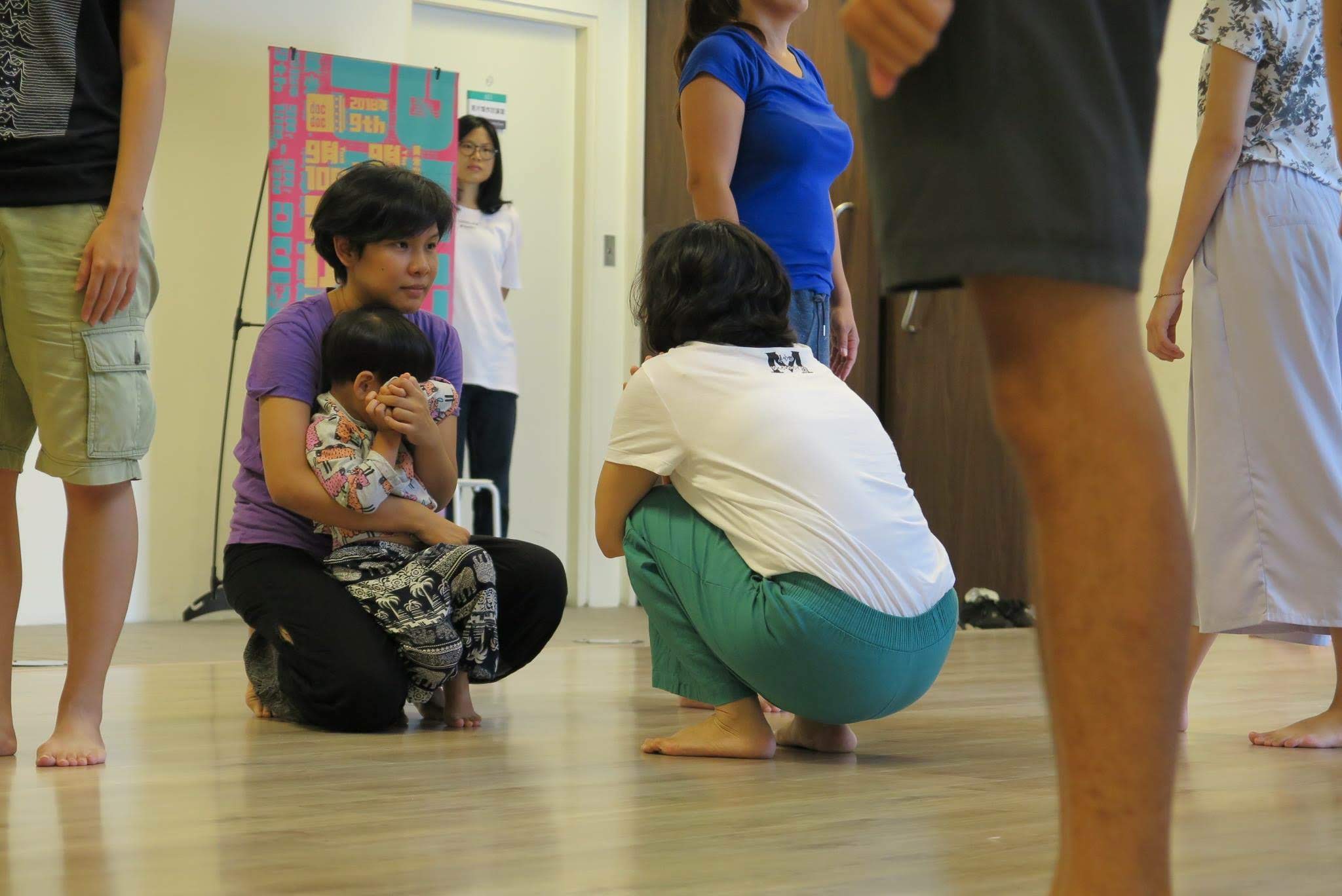
First time attending the DOC DOC Documentary Workshop (Photo provided by Kite Chen)
The 17 documentary filmmakers would gather at the rehearsal space every two weeks on average. Kite often brought her four-year-old daughter A-Bao with her. In rehearsals, we focused on untangling the knots in our minds, keeping each other company as we slowly pulled out the threads, connected them together, and worked together to weave a colorful web. I don’t remember when it started, but Kite, whose topic was originally about her deceased father, began to express all the complexities, doubts, struggles, and pain that came with her trying to coexist with her identity of being a “mother” in every improv session.
Out of weakness, I quit the rehearsals and performance halfway through, but Kite and the others ended up creating a very complete performance, “Experiment 067.” Later, I heard at several gatherings that Kite continued to work on a documentary feature film on mothers who are candidates of the “Taiwan Obasang Political Equality Party.” Last year (2023), Kite told me that the film was in post-production and invited me to be an observer to compile and record the changes in the film along the way.
Five years flew past in the blink of an eye. From the time she faced the frustrations of motherhood in our rehearsal space back in 2019, Kite has carried the identity of a mother for another five years. I was curious whether her feelings about living with this identity changed over time. Did this identity affect her thinking or choices in making this film? Furthermore, how did the process of making a documentary about “mothers” impact her?
About Kite
Kite Chen is a daughter, wife, mother, and the third oldest of four sisters. Her career mainly revolves around the field of documentaries.
Kite’s relationship with documentaries began with an assignment for the course “Visual Anthropology” that she took as a senior in the Department of Ethnology at National Chengchi University. For the assignment, she filmed an Egyptian man selling shawarma in the Gongguan district of Taipei City. However, she did not limit herself to simply creating documentary films. Later, while studying at the Graduate Institute of Documentary & Film Archiving of Tainan National University of the Arts, she participated in the organization of two Ethnographic Film Festivals, the Free Tibet Film Festival, and the release of “Stone Dream.” She also worked on academic research and wrote film reviews.
First-person autobiographical documentaries were at the height of popularity in Taiwan at the time. Many of Kite's upperclassmen at university turned their cameras inward on themselves or their family members to explore the issues in their lives. Although this type of documentary has attracted a lot of criticism from academic circles that find the format too casual and lacking in fieldwork and publicness, Kite was strongly drawn to them. “I think the expression of personal emotions and experiences is also very important, and could even be a way for creators to face and resolve issues in their lives.”
So she picked up her camera and focused on issues she cared about most at the time, independently completing two documentaries, “My Mom's Daughter” and “Avoiding Vision.” The former is an attempt to clarify her long-standing anger toward her mother, while the latter aims to describe her relationship with her own body. These works show that Kite regards documentaries as a tool of exploration and expression rather than just a medium for recording and public dissemination.
Kite later went to study abroad in France, where she also worked on production and research at the same time, focusing on first-person films, family films, biographical films, and diary films that explore private life. In other words, Kite’s participation in documentaries encompasses the creation, research, as well as planning of programs and organizing activities to share with the audience. Moreover, she never limits herself to a certain identity. Editor Chen Hui-Ping, who has known Kite since they were both at Tainan National University of the Arts, revealed, “Kite was sharp, full of confidence, and could always accomplish everything she wanted to do.”
Unexpected Setbacks in Motherhood
In 2012, Kite returned to Taiwan from France and began to participate in the production of documentaries as a freelancer. Working on one film after another, her life was busy and fulfilling. However, the Kite who always did what she wanted and did it well faced a new challenge in 2015—she became a mother.
Even though it was a planned pregnancy, and even though Kite felt that she was prepared for it, the reality of motherhood still filled her with stress and helplessness, “I realized that no one can really prepare themselves to be a mother. Motherhood was completely beyond my imagination.” she said.
Wanting to focus on being with her child for three years, she opted not to send her daughter to a nanny or daycare, and decided to breastfeed and practice attachment parenting. These choices completely upended Kite’s original lifestyle. “The baby needed to be fed every two hours, and slept for extremely short periods of time, often waking after just 40 minutes of sleep.” The demanding work of childcare cut Kite's everyday life into broken fragments. She could barely leave the house and had no real time for herself. “Under those circumstances, I felt that it was impossible for me to take on any more film making cases.”
Kite believes that what she actually needed was a “breath of fresh air.” “For example, it would be nice to have two days a week where I can do my own thing. But it is very hard to find temporary nannies in Taiwan.” Taiwanese law stipulates that nannies can only care for two children over the age of two and two children under the age of two at a time. As a result, it is hard to find nannies who are willing to take care of children temporarily because they would rather care for as many regular charges as possible.
In addition, motherhood is not only a physical strain, but also a tremendous psychological and emotional challenge. “From your childhood, your family background, and your relationship, to your identity and self-worth, they all implode when you take on the role of a mother, and you are forced to face it all yourself.”
Even if your partner does their best to do their share of childcare, most of the childcare and housework responsibilities still seem to naturally fall on women. It’s hard to entrust your child’s development, health, and dietary arrangements to others. Without much of a support system, the role of “mother” gradually took over all of Kite’s other identities, becoming the only focus in her life. This was extremely frustrating for Kite and made her feel more vulnerable than she had ever felt before.
“All my friends were starting to make their own films, whether they were individual projects or interesting crossover collaborations. It was very painful for me to see everyone adding to their portfolios and gaining experience at such a rapid pace. During those two years, I really felt like I was being left behind. I even panicked because it felt like I had to start all over and I couldn’t keep up.”
A Turning Point - Joining Parent-child Groups
Fortunately, Kite joined a parent-child group when her daughter A-Bao was one year old, and this experience became a turning point in her struggle with motherhood. She joked that the parent-child group was like a cult and that once you join, you can never leave.
Kite once saw mothers from a parent-child group marching with their kids at a gay pride parade. At the time, she told herself that if she ever had a child, she would definitely do the same. In the parent-child group, Kite found like-minded parenting partners - a group of “unconventional moms” who faced the same challenges in parenting and also chose to look after their children themselves. They emphasize parenting values like “no hitting, no yelling, no threats, no bribes,” fully respecting “children's human rights” and refraining from making “choices that go against children’s wishes.” In participating with children in social and political situations as well as everyday life and play, these parents support each other and grow together as they cultivate necessary parenting skills.
The experience of being accepted and inspired by the parent-child group, as well as the fact that A-Bao became old enough to play with other kids in the parent-child group, enabled Kite to finally regain some motivation and time to pick up her camera again. She began filming everyday activities in the parent-child group, documenting how these “unconventional” moms interact with their children. “We would go on marches together, or even hold press conferences with our kids to demand family friendly carriages. These are such strong moms, I thought,” she said, “But I was simply drawn to this group of people and this subject matter, and hadn’t really thought about what I wanted to film and how I wanted to film it.”
At first, she was just casually gathering footage. It wasn’t until the “Taiwan Obasang Political Equality Party” was established in 2018 that her filming took on a more specific direction.
The members of the “Taiwan Obasang Political Equality Party” mainly come from parent-child groups all over Taiwan, and the founder of the party, Chang Shu-Hui, just happens to be the leader of Kite and A-Bao’s parent-child group. This meant that Kite had a front row seat from the start, and she watched 21 moms across Taiwan prepare to run for city and county council members.
“When I first heard about it, I thought ‘this is crazy!’ I'm sure any documentary filmmaker will find this to be a very rare opportunity!” Kite said. “There’s also the question of whether you can film for a long time and whether you can get a lot of footage. These all require a lot of time in the field. But I’ve basically been in the field since 2016, so I asked if I can film them.” And that is how the film “Matrescence” came to be.
Establishing the Two Subjects - Liu Hsin-Yi, Chen Wan-Yu
“Matrescence” follows two women, Liu Hsin-Yi and Chen Wan-Yu, documenting their self growth, awakening, and strength after becoming mothers, and their journey of going into politics. The film covers two county and city council elections, spanning almost five years. At the start of the project, Kite actually only planned to feature Liu Hsin-Yi as the main subject.
Born in 1987, Liu Hsin-Yi got pregnant and married not long after graduating with a degree in early childhood education, becoming a naive young mother. She said that she was very lonely at the time. Her husband, who works in real estate, often worked overtime, leaving early every morning and coming home late. Alone in their small apartment, she could only rely on Google to find answers for all the doubts and problems she had with parenting.
Hsin-Yi later joined a parent-child group with her son. Though she used to be disinterested in politics and never once participated in any social movements, she began to pay attention to issues like the childcare environment and early childhood education, and often participated in advocacy campaigns. In 2018, she answered the call of the Taiwan Obasang Political Equality Party and joined the election campaign, becoming a city councilor candidate in the second district of New Taipei City (Xinzhuang, Taishan, Wugu, and Linkou).
Even before she ran for the election, Hsin-Yi was taking action to address how hard it was for moms who need a break to find trustworthy nannies that also provide temporary childcare services. She established a babysitting system in the group, in which moms in the group can take turns looking after each other’s children, giving other moms time for themselves. Hsin-Yi even borrowed an empty house her husband owned to provide space for these childcare activities.
Kite was fully on board with Hsin-Yi’s proposal and joined the babysitting system. She also developed a closer friendship with Hsin-Yi. Therefore, when Hsin-Yi decided to run for city council, Kite naturally asked if she could film her. Hsin-Yi agreed, so Kite began devoting herself to filming Hsin-Yi’s 2018 election campaign.
However, all this filming in 2018 was a big challenge for Kite, who also had to juggle the responsibilities of motherhood. She had to get up while her partner and three-year-old daughter A-Bao were still sleeping to film Hsin-Yi’s campaign activities, such as visiting traditional markets, handing out leaflets, holding up signs, and making speeches on the street. These activities usually started at seven in the morning, so she could rush home at nine o’clock, just in time to take over childcare duties as her partner headed out to work.
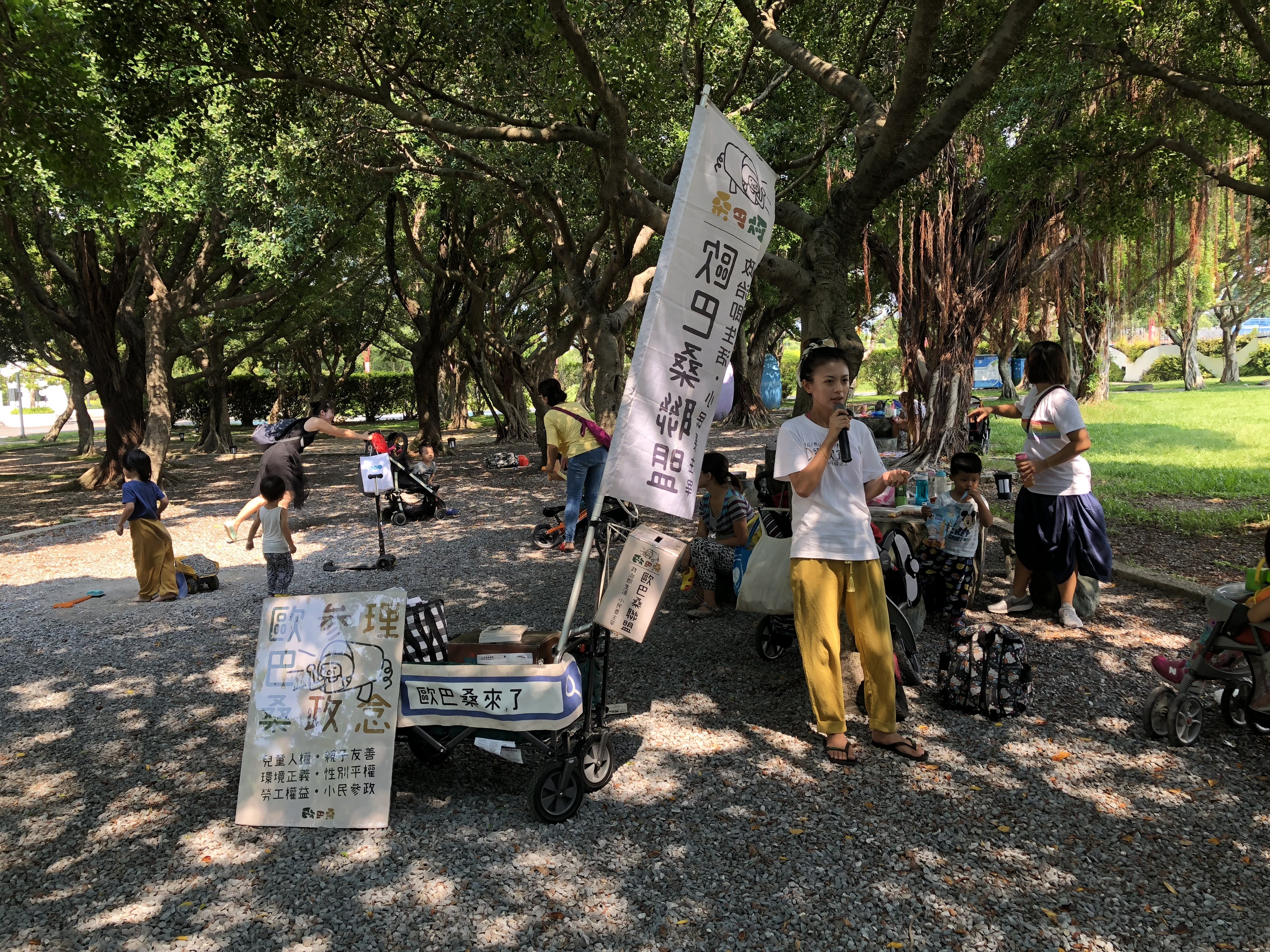
Hsin-Yi making a speech in a park in 2018 (Photo provided by Kite Chen)
“At the time, I was happy to be able to go out and do anything alone. It didn’t matter how early I had to get up,” Kite said. But the times she was able to film were too few and far between, and A-Bao still needed her to sleep by her side at night, so the filming in 2018 mainly focused on campaign related scenes and events. She was unable to capture the everyday moments in Hsin-Yi’s life when she returned home late at night after a long day of campaigning.
Just when Kite felt that the footage she had filmed wouldn’t be enough to make a complete documentary, Hsin-Yi, who was little-known and only rented a small booth in the local market of her district to sell second-hand goods for funds and promote herself, actually managed to become second alternate for councilor in her district (the first alternate was the candidate of the New Power Party, while all elected candidates were from the two major parties). Although she failed to get elected, this result was still shocking to many. It not only gave Hsin-Yi the ambition to campaign again in the next term (2022), but also made Kite feel okay to not rush to finish her film and instead continue filming and wait for further developments for a more complete story line.
The four-year gap between elections was neither too long nor too short; it was just enough for many key changes to occur. After the election, Hsin-Yi devoted herself to Taiwan Obasang Political Equality Party's party affairs and gave birth to her second child in 2020, becoming a mom of two. Unexpectedly, just before the 2022 election, Hsin-Yi became pregnant with her third child and decided to give up her candidacy. This shocked Kite, who worried about how to continue her film with Hsin-Yi absent. She determined that the footage she filmed from 2018 to 2021 wouldn’t be enough to present the full story. After much consideration, she decided to introduce another subject who was also campaigning for election while taking care of her children—Chen Wan-Yu.
Born in 1988, Chen Wan-Yu is a mother of three children aged 11, 9, and 5 years old (as of 2022). After getting married and having kids at the age of 22, she worked part-time while taking care of her children. When her eldest child was three years old, she decided to join a parent-child group because she found it difficult to balance the upbringing of her two children. It was in the parent-child group that she gradually developed some views and concerns regarding human rights and society.
In 2018, Wan-Yu and her kids accompanied Hsin-Yi to help her manage her stall and campaign in the streets of Xinzhuang Market. She was deeply inspired by Hsin-Yi, which is why in 2022, she decided to run for city councilor in the 4th District of New Taipei City (Sanchong and Luzhou).
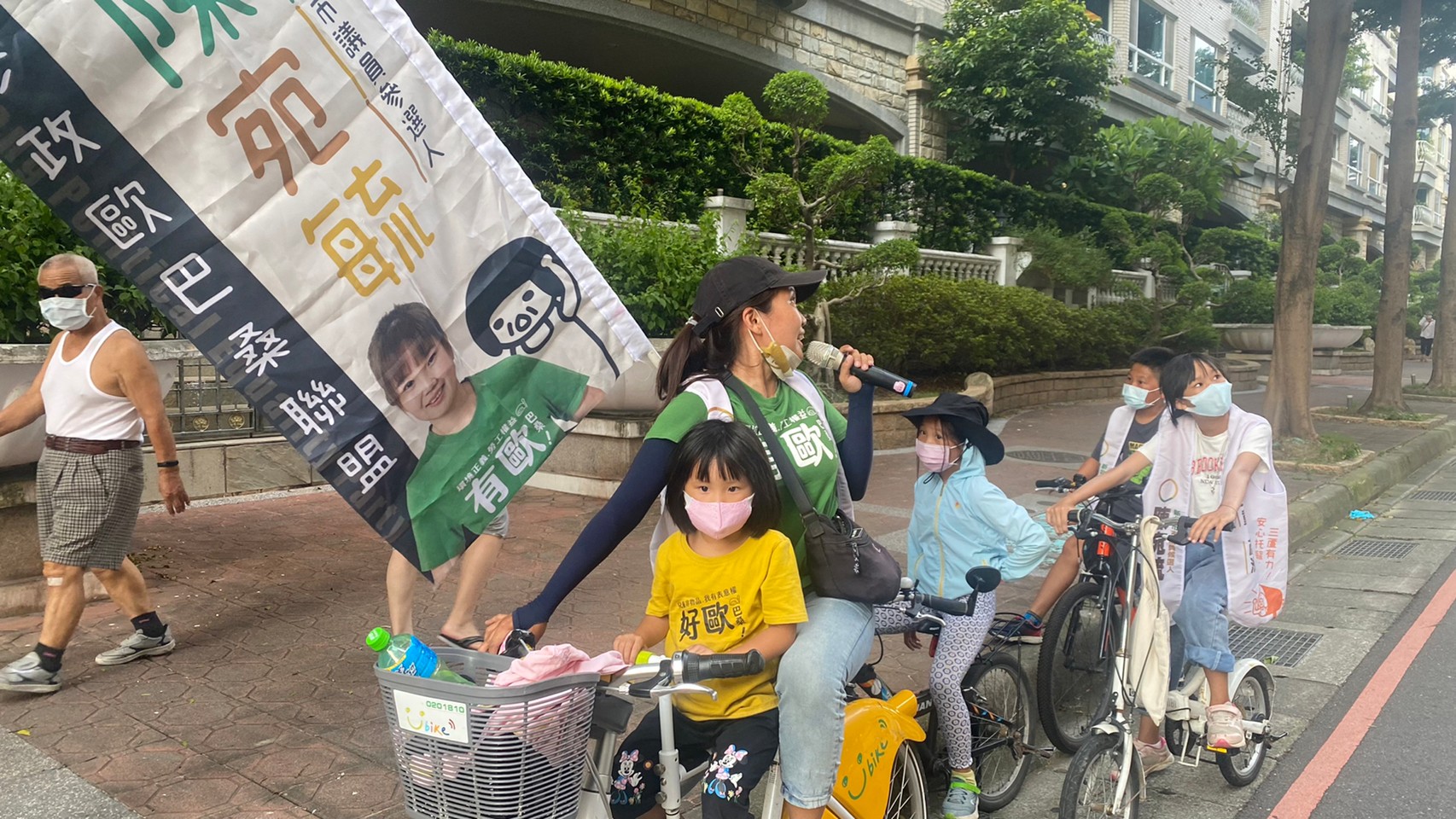
Wan-Yu campaigning on the street with her children in 2022 (Photo provided by Kite Chen)
Kite recalled that her first impression of Wan-Yu was from the time she heard Wan-Yu give a speech on “Family Democracy” at Chè-lâm Presbyterian Church. “She has three kids, so they’re always trying to decide what to eat and who gets to sleep next to mommy. She said this was an exercise of democracy at home. Should we decide by voting? Is that fair? Should the older child let their younger siblings have their way? Is that fair? Should the younger ones listen to the older ones? Although I only have one child, I found these discussions fascinating.”
Practical considerations are also important. For Kite, Wan-Yu's district is more convenient for her to film than that of other candidates. With registration and election activities approaching, “what made her decide to put herself on the front line and join the political election?” “What kind of self actualization and values does she want to achieve by running for office?” “Her youngest is even younger than A-Bao. How will she balance the election and childcare?” With these questions in mind, Kite began to shift part of the focus of the documentary to Wan-Yu's story.
Kite had experience from the last time around, and A-Bao was four years older this time, able to behave and communicate when she tags along on Kite’s shoots. Kite even received a grant from the National Culture and Arts Foundation, which enabled her to work with a producer and photographer. This time, Kite was more conscious about filming and recording how Wan-Yu campaigned and worked part time with her children in tow, how she interacted and communicated with her children, and her setbacks, fatigue, and concerns along the way.
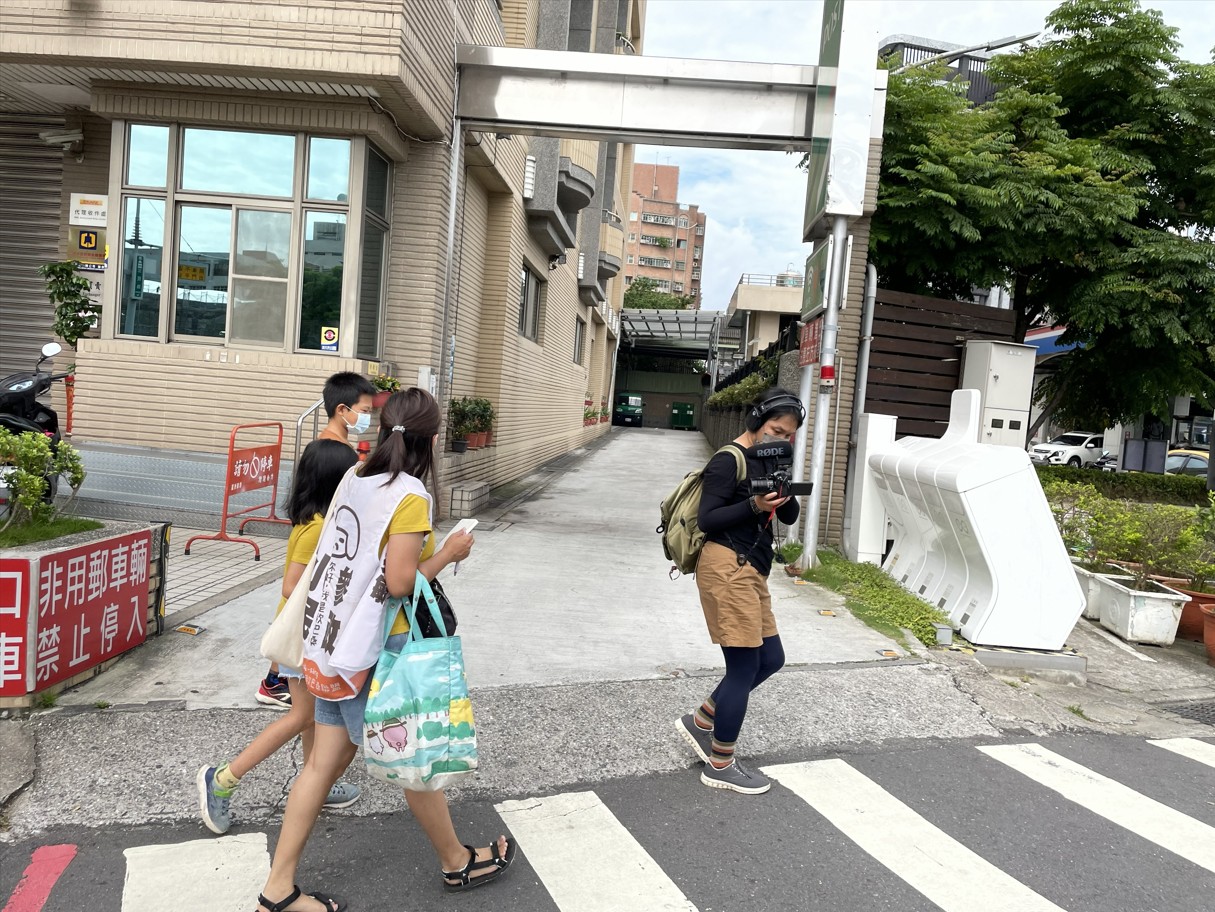
Filming street campaigns (Photo provided by Kite Chen)
Challenges in Post-Production
After filming came to an end, it was time to sort through and edit the huge amount of footage she had. Kite recruited Chen Hui-Ping, a fellow graduate of Tainan National University of the Arts who also worked on documentary theater to be the editor and prepare for the upcoming editing workshop for National Culture and Arts Foundation's “Documentary Support Project” (July 2023).
However, Kite admitted that at this stage, she still didn’t have a clear idea about how to structure the film, and even felt stuck. There was such a significant gap of time between the stories of her two subjects, who also had completely different personalities and situations. Kite was most worried about how to appropriately edit their stories into two non-conflicting but not totally parallel story lines that won’t confuse the audience with different time lines, and integrate everything into one film.
In addition, about 70% to 80% of her raw footage were that of campaign activities. Election footage has a strong visual impact and easily attracts the audience's attention, but they could also weaken the few scenes of her subject’s home lives. Also, how should they balance the personal and political content if they wanted to convey the values of Taiwan Obasang Political Equality Party and the parent-child group to the audience? These issues made it all feel so difficult.
Later on, Hui-Ping tried to first set aside the aforementioned issues and simply arrange the footage in chronological order, dividing the stories of Hsin-Yi and Wan-Yu into two independent sections. She did her best to include all the clips that she found interesting, touching, and meaningful, creating a five hour long version. After that, she and Kite worked together to edit it down to a two-hour version, then submitted it to the editing workshop as a basis for discussion with the workshop mentors.
As expected, their initial worries were reflected in the honest feedback they received. The mentors all gave similar comments such as, “I hope this film can provide a more in-depth exploration of what this mother-centric political party is actually advocating.” “Their motivations for running and their political platforms need to be clearer.” “I want to know what difficulties these moms encountered when they run for election. What do they inspire in our society?” However, these suggestions were the complete opposite of Kite's original intention.
“I think the editing workshop made me realize that we were too hung up on the ‘election’ part,” Hui-Ping said. “After watching the rough edit, what everyone saw was the ‘mom candidate,’ with the focus on ‘candidate,’ but we want to focus to be on ‘mom.’”
After the editing workshop, Kite and Hui-Ping decided not to make the election the focus of the film (it was still titled “Mom’s Campaign Diary” at the time). After all, running for election was actually just a choice, an exercise, and an experience for the two women, Hsin-Yi and Wan-Yu, on their road of motherhood. But what Kite wanted to extract from their stories were the status and details of their coexistence with the role of motherhood, whether in the public sphere, political sphere, or everyday life.
Through the two subjects, Kite wanted to show the audience the complexities and diversity that motherhood brings to women. She didn’t want the audience to simply label their story as “the strength of mothers” and believe that “these mothers are taking to the street for the sake of their children” while ignoring the mothers’ own subjectivity.
Clarifying the Film’s Central Idea
Therefore, Kite began re-shooting scenes from the two subjects’ everyday lives and also conducted in-depth interviews with both of them. Before this, they never had time to sit down for an interview because of how hectic shooting gets and the fact that they all needed to take care of their respective children.
After hearing about their family backgrounds and life experiences before becoming mothers, Kite and Hui-Ping gained a new understanding of the two subjects. Hui-Ping said, “At first we only saw these abstract and beautiful ideas, but after the interview, we realized that they were the concrete results of these women’s reflections along the way. The interviews allowed us to return to the ‘process’ and understand their life, choices and feelings.”
As a result, Kite found a clearer central idea that she felt more sure about - “how to women encountered the frustrations of motherhood and how, step by step, they grew, made breakthroughs, and were reborn.”
Becoming a mother seemed to be a natural and clear choice for Wan-Yu. Coming from an underprivileged background, she always wanted to start a family of her own. Her experience of receiving help as a child turned into motivation for her to run in elections and participate in social movements. “Wan-Yu took being a mother from the family level to the social level,” Kite said regarding Wan-Yu’s motherhood trajectory. “She participated in political actions with her children to heal her childhood trauma and in a way grow up once again alongside her children.”
Hsin-Yi's motherhood journey, on the other hand, was as full of struggles as Kite's. At first, all she wanted was to break away from being a mom and get her own time and space back. This drove her to join the initiative for childcare reform. Participating in the election was more of a way for her to break free from the role of motherhood and discover her self worth. “When I ran for election, I was fully ‘Liu Hsin-Yi.’ I got a deep sense of my own strength, so now I can go back to being a good mom, to experience all the ups and downs of being a mother.” This description helped Kite understand why Hsin-Yi chose to have a second and third child after the election.
The two women’s journeys of motherhood had markedly different, even opposite, paths. Therefore, in the film, audiences can see Hsin-Yi on her own, firmly communicating with passers-by who questioned her, as well as Wan-Yu making props and handing out fliers with her children. Audiences can also see Hsin-Yi gently soothing her second and third child, as well as Wan-Yu getting angry and quarreling with her husband because she doesn't want the election to affect her children's lives.
Society often brushes off the setbacks, struggles, and difficulties of motherhood with phrases like “mom, thanks for your hard work” or “moms are great,” but Kite wants to showcase all the details of motherhood. “I don’t want to paint all women with the same brush with the ‘mom’ label. After all, whether it's how you are as a partner at home, how you act in front of your children, how you play your role in society... there are many facets of motherhood, and every mother is different.”
In addition, we often see news stories of mothers who “finally pursued her dream after her children are grown.” These stories are moving, but must a mother wait for her children to grow up to be “reborn?” Does this so-called “rebirth” mean letting go of the role of mother? Is it impossible to be yourself and even develop a new self when you are a mother?
“I think my own frustrations often came from the feeling that my role in society was overwritten by the fact that I was a mother. It’s like women often have to choose between the two—if you want to be professional, you have to rein in your image as a mother; if you want to be a good mother, it seems you have to give up your role in society. I don't want these to be my only options,” Kite said, “From being mothers to social engagement, these two roles are always intertwined for these two subjects. They didn’t abandon any role, nor consciously try separate them or choose one over the other.”
“I think my own frustrations often came from the feeling that my role in society was overwritten by the fact that I was a mother. It’s like women often have to choose between the two—if you want to be professional, you have to rein in your image as a mother; if you want to be a good mother, it seems you have to give up your role in society. I don't want these to be my only options,” Kite said, “From being mothers to social engagement, these two roles are always intertwined for these two subjects. They didn’t abandon any role, nor consciously try separate them or choose one over the other.”
Through these two different women in the film, Kite hopes to show more diversity and spark different ideas about “the setbacks and rebirth of motherhood.” For this reason, she changed the title of the film from “Mom’s Campaign Diary” to “Matrescence.”
The work’s Chinese name “女子女馬” was inspired by her friend Ho Ching Chwang's essay “女馬”, which explores the sexual impulses of adolescent women. Although the title of the film is not directly related to the imagery of the essay, it made Kite think about how the Chinese characters for “woman” and “child” form the word “mother.” After all, becoming a mother is more than just a single identity. It can be achieved by both the woman and her children. The concept of a “good mother” often makes women feel lost, trapped in the pressure of social and self expectations. As a result, motherhood has become a process of constant self-sacrifice and exploration, the complexity and fluidity of which require continuous questioning and discussion.
Rewarding Teamwork
After filming in 2018, Kite worried that because she was too familiar with the subjects, she would be unable to maintain an appropriate distance and an objective outside perspective. Therefore, unlike her previous solo efforts, she decided to make “Matrescence” a team project.
She first went to producer Lin Kuan-Ting. Kuan-Ting had previously written “The Song of Obasang” and was familiar with the Taiwan Obasang Political Equality Party. Although this was her first time producing a documentary, her discussions with Kite helped her sort out her chaotic thoughts and raise key issues. Kuan-Ting also relieved some of Kite’s work stress during filming. Previously, Kite had to take care of driving, filming, interviews, and communications all on her own. Now that Kuan-Ting could help handle the logistics and arrange shooting schedules and shifts, Kite could focus more on filming. This not only made Kite feel more supported and cared for, but also made her work go significantly smoother.
The addition of another photographer also gave Kite a different perspective. A lot of filming during the elections was done on very short notice, so there wasn't enough time to send someone out to film every session, but collaborating with the other photographer still made Kite appreciate the synergy that can be achieved with teamwork. “As a director, perhaps I'm not as good at getting the ideal images, but when the photographer understands what I want to say, they can use their professional expertise to capture the moment when form and content overlap for me.”
Choosing to work with editor Hui-Ping was a crucial decision for Kite. “I actually didn’t want to bring in an editor at first. Firstly, I had budget concerns, and secondly, I thought that it would be too tiring to explain my creative vision to someone else, and that it would be easier for me to edit the film myself,” said Kite, “But as an outsider who was not a mother and didn’t have kids, Hui-Ping could help me avoid making the film too internalized, so that even those who aren’t mothers can understand it. I also relied heavily on her interpretation of the characters, which balanced my over-familiarity with the story and made the characters more convincing.”
Kite barely provided Hui-Ping with an outline. Instead, the two would chat to generate inspiration. Hui-Ping believes that the footage serves the starting point for her to understand the characters and the basis for constructing the story in a film. Therefore, when Kite approached her to collaborate on this project, she chose not to listen to too many explanations at first, and instead began getting to know the two subjects by exploring the footage directly and taking her own notes.
Hui-Ping emphasized that these notes were not only an evaluation of the usability of the footage, such as comments like “too shaky,” “can use the face, not the audio,” or “this dialog is great,” but also her observations of the characters. For example, she would write comments such as “Really? Is she being too naive?” or “I don't believe her tears” next to certain clips to record her feelings from the perspective of an outsider (and possibly the audience). These comments helped her better understand the footage and evaluate how to use them in the future in order to construct a persuasive point of view.
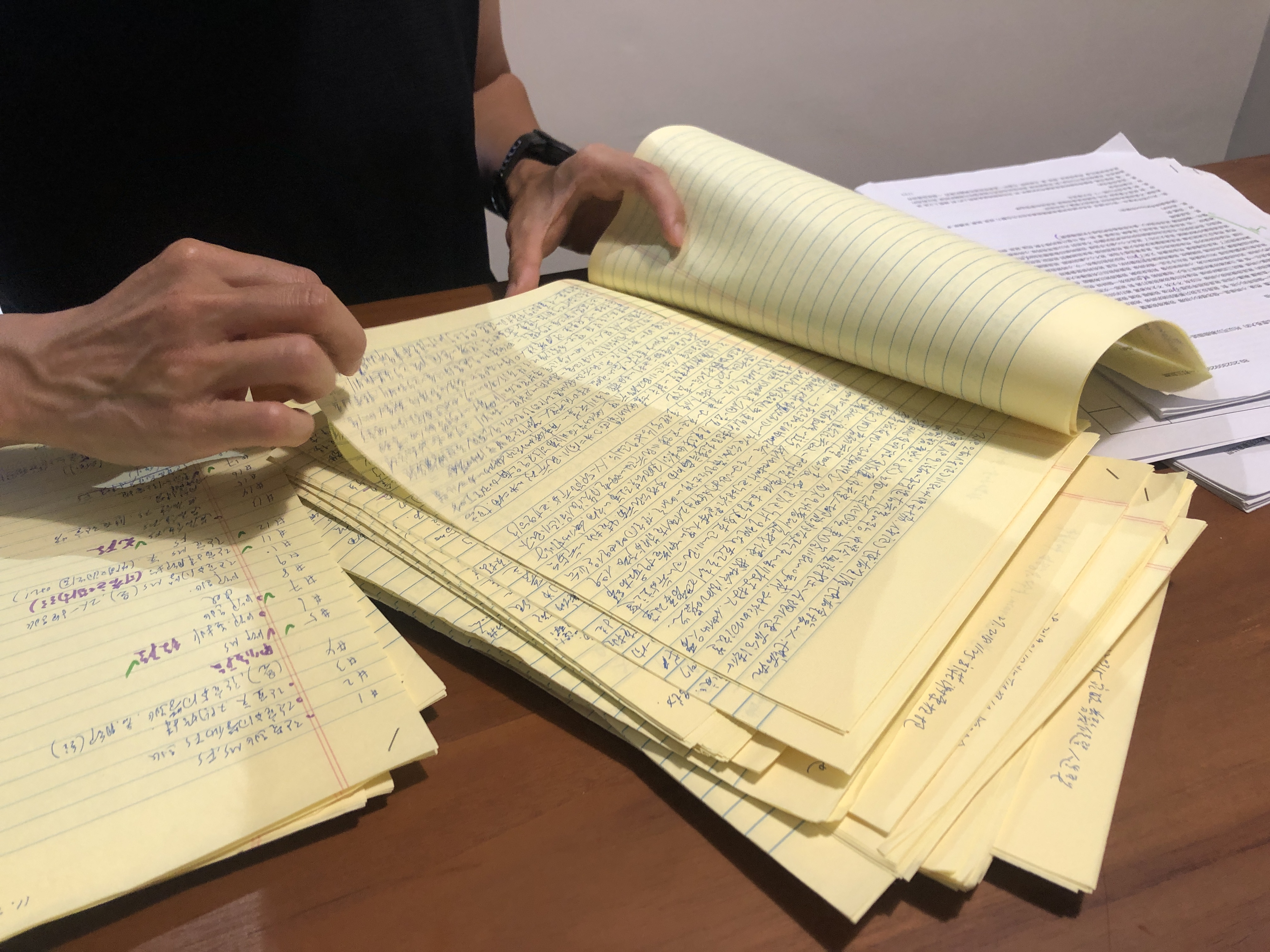
Hui-Ping’s notes (Photo provided by Kite Chen)
After Kite decided that the core of the film would be “the setbacks and rebirth of motherhood,” Hui-Ping began to use the footage to analyze the similarities and differences between the two subjects in terms of their family backgrounds, how they interacted with their kids, their participation in the parent-child group, their election campaigns, and their self-actualization. She then made a breakthrough with the issue of chronology that troubled her before, ultimately intersecting and integrating the two narratives of the subjects. As of writing this article, they’ve finalized the general structure and narrative of the film and are expecting to organize another round of small test screenings to gather comments before editing a final version.
Hui-Ping and Kite both mentioned how Liao Ching-Sung (Liao-san), their mentor from the “Documentary Support Project” editing workshop, helped and inspired them in their editing work. Liao-san had asked to watch their five-hour rough cut, then spent two days at Kite’s house, where he opened the editing project file directly to discuss it with Hui-Ping and Kite, and even performed some demonstrations on the spot.
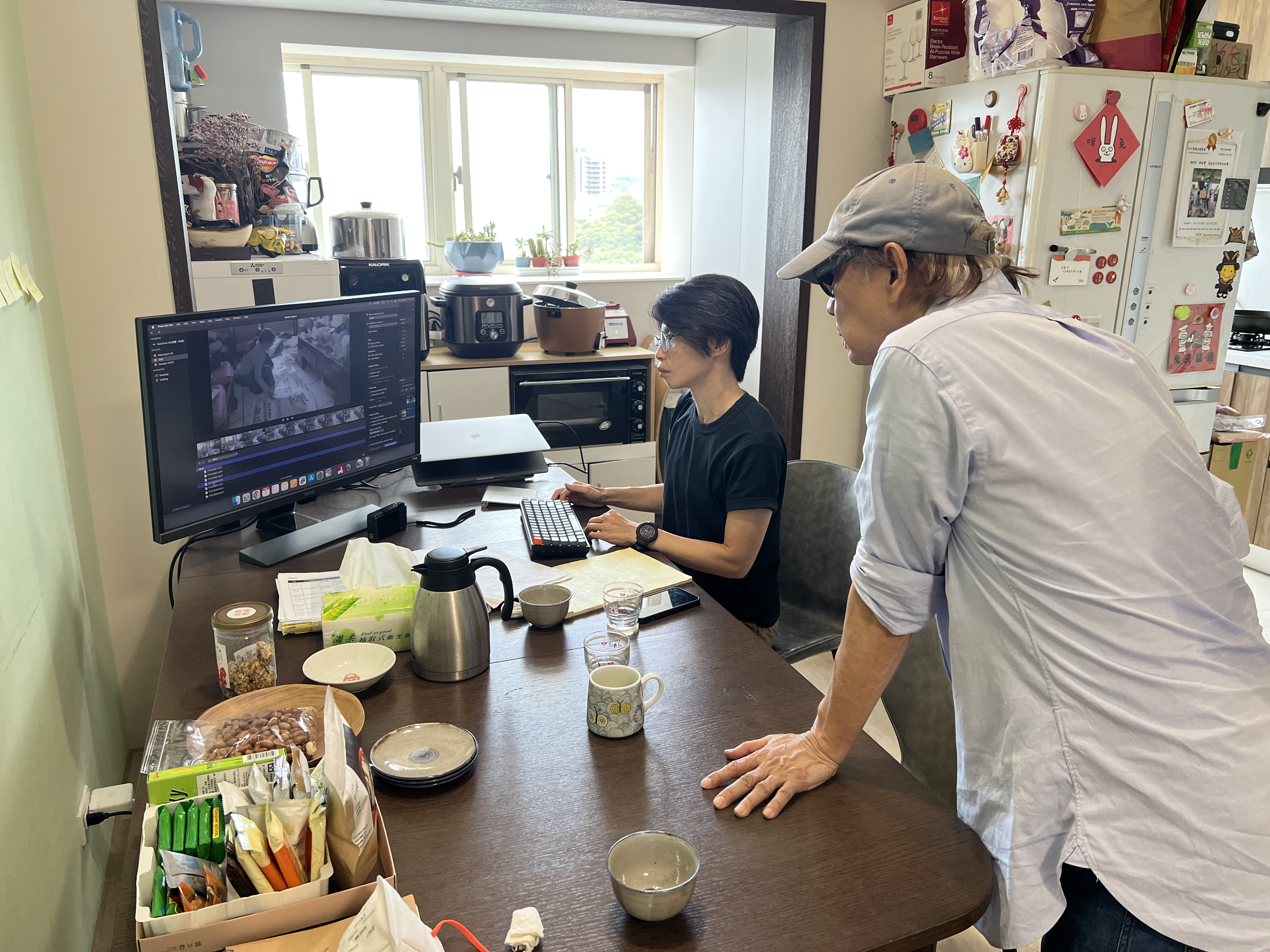
Working with Liao-san (Photo provided by Kite Chen)
“Cut loosely, don't cut it too precisely.” That was Liao-san’s first suggestion to Hui-Ping after seeing the rough cut. “Liao-san said that of the footage conveyed too strong a purpose, or when all my footage was focused on one thing or instilled one message, it could backfire and turn the audience off instead.”
His comments led Hui-Ping to reflect on whether her years of experience working on commercial cases had caused her to develop formulaic editing habits. But what does “cut loosely” mean? Make the clips a little longer? Put in more footage? Maybe leave some scenery shots? “On the second day, when Liao-san gave us a demonstration, I realized that it meant to leave some leeway, to take a breath, to leave some space for audience participation instead of talking the whole time and filling the entire runtime with what I want to express,” Hui-Ping said.
Hui-Ping recalled that Liao-san kept reminding her “not to rush to get it right in one step,” because “films are like people, you need time to get to know each other. If you spend a lot of time with it, you will understand it very well.” Therefore, the editor should include all possibilities in the editing process, putting any material they think is good into the project. “Put it in and see! Just put it everywhere! See how putting the clip in this position feels. You need to think with your eyes, think with every cell in your body, instead of just your head.” Hui-Ping said with a laugh that for a while after the editing workshop, she felt as if she didn’t know how to edit anymore, but she is also glad for the opportunity to re-examine her editing mindset and habits.
“Although I'm still not sure what ‘cut loosely’ means, I will keep this reminder in mind when editing. Sometimes, I would stop looking at or thinking about it for some time, and then when I look back later, I would suddenly find blind spots or problems in my editing that I can modify and adjust.”
“Edit the scenario, not the process” is another important concept that Hui-Ping and Kite learned from Liao-san. Having been making documentaries for a long time, they often feel bound by the footage of real events and feel like they must present things as they are. Therefore, they are often stuck putting clips in chronological order, which makes the flow feel too slow. Liao-san, who has a lot of experience in feature films, pointed out that “establishing characters” is more important than conveying information.
For example, Wan-Yu’s first scene in the film was originally her press conference announcing her city councilor candidacy, but Liao-san suggested that they change it to her coming home exhausted from a full day of campaigning. “We should first see her as a person, you don’t need to rely entirely on the real sequence of events.” They initially included clips of all five things Hsin-Yi did before going out to show how she was used to taking care of everything for her children, but Liao-san managed to establish a clear and powerful portray of Hsin-Yi’s character and the situation with just three shots.
Kite and Hui-Ping also used this concept to rethink the proportion of political scenes in the film. How could they adjust it so that people won’t only see politics? Consequently, they decided not to spend a lot of time covering the ideals of the Taiwan Obasang Political Equality Party and the two candidate's platforms, and removed overly similar and repetitive shots of campaign activities. In addition, for scenes related to Wan-Yu’s election, they focused more on her struggle to run for election without sacrificing the quality of her parenting. For Hsin-Yi's part, they used a collection of clips to showcase her shining facial expressions and powerful drive as she spoke her convictions and win over voters in her very grassroots, very “Liu Hsin-Yi” way.
Gather, then Expand
Kite didn’t start out with a clear vision. She simply found a good subject while struggling with motherhood and decided to pick up her camera. Five years has passed, and her footage is about to become a complete film.
In the past, Kite has always regarded documentaries as a way to explore difficult problems in her life. She confessed that “Matrescence” has been the most painful and tormenting film for her to make in her life because although its subjects are Wan-Yu and Hsin-Yi, it completely overlaps with her own motherhood journey. “It just seems that in a sense, this film accompanied me in the process of becoming a mother, as I faced dark moments, experienced the loss of control and self-blame, and gradually began to learn and change.”
In this process, Kite repeatedly tried to clarify whether the dilemma she faced with motherhood is personal, or something that occurred frequently under the current social system. Does this issue that she cared so much about matter to others? “Matrescence” is like a retrospective of Kite’s experience of living with motherhood in the past decade, one that tries to talk about what it is like to “be a good mother.”
“My wish is to use the weight of a film to at least present this process. I personally believe that it is important to make documentaries on social issues. Their value to society, reminders for society, or criticisms of society are all very important, but many people are indifferent to these issues. So I’ve always felt that drawing from our everyday lives is a very good way to bridge this gap so that everyone can engage with these issues and see themselves.”
Does Kite think she is reborn now?
“It's more like a new look. I took a path I had never seen or even thought about before. I experienced this path, and it changed my whole person.”
“I am very happy to be a mother, and I am very happy to have A-Bao.”
“I think this is a more down-to-earth life.”
---
*Translator: Linguitronics
More CASE STUDY
_1685344611325.png)